
 July 30, 2026 "Less IS More"
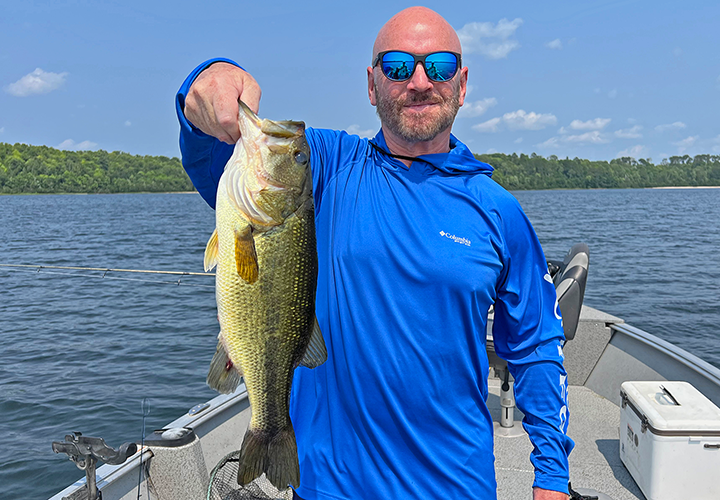 You’ve heard the expression “less is more”, and so have I. The subjective term can be used in many ways, some more meaningful than others. Today, I offer you my own, admittedly subjective and conditional definition of the term which for today is, “Less, Walleye Fishing, equals More, Fun!”
Don’t get me wrong, I’m all for chasing walleyes; I truly do love them. But why would anybody choose grinding away in the hot sun all day long for a half dozen bites, when instead, they could enjoy A LOT more action? For me, catching 20, 30, or even upwards of 50 hard fighting sunfish, crappies or bass is just plain more fun. And even if you’re only in it for the food, I’ll argue that panfish, pike and perch rank right up there with walleyes in terms of great eating.
This week, water temperatures are reaching up into the high 70s. I’m seeing 78 to 79 degrees on most lakes. The weed growth is at summer-peak levels, lush and green growing tall. Combine that with loads of sunshine and calm water, and walleye fishing has been a struggle. We can catch some, but not without “working” at it. I can get most folks enough for a good meal, but I’m far from sending folks home with limits of walleyes.
Conversely, the sunfish, crappies, largemouth bass, perch and other fish are striking aggressively. Most days, I can count on keeping people busy all day long provided they are eager for a mixed bag. Last week, I fished with a family of 12, and they had no problem getting enough fish for both a huge fish fry, and a respectable bag to take home. This week, Patterson’s fed a family of 8 on the catch from Sunday alone. That freed them up for 2 full days of catch and release, action fishing.
 On Monday, we trolled spinners and caught sunfish, pike, crappies, largemouth, smallmouth and rock bass. Those fish were all released, and by Wednesday, we’d already had plenty of action. Patrick was ready for the goal of catching some larger bass, hopefully with decent numbers to provide action.
Logistics was a factor, so I looked at the map and selected a lake near their resort with good potential. The lake, about 500 acres, has decent crappies and that’s the only species I’d pursued there in the past. I was aware of its bass population, but when I checked the lake finder website, found out that largemouth bass are the MN DNR’s primary management goal for the lake. That goal, according to our experience yesterday, is being met.
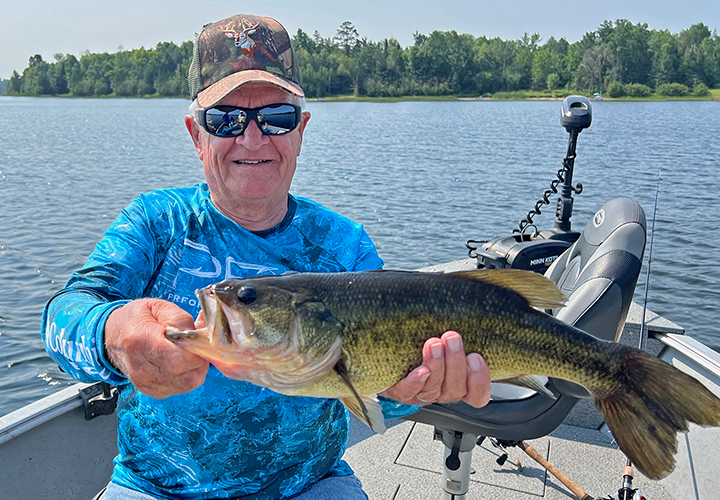
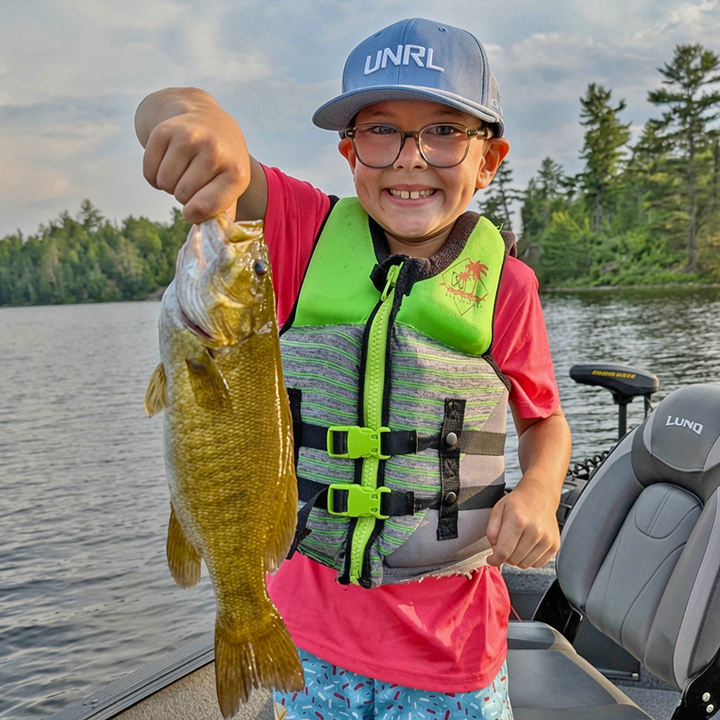
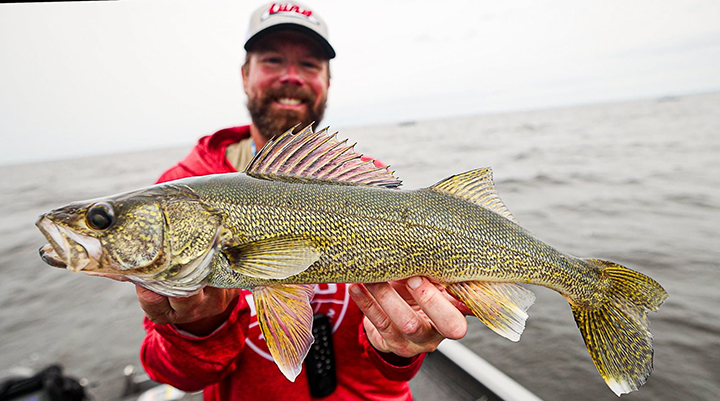
Our largest fish, caught by Gary Patterson and pictured here, was 19 inches long. That may not be considered a lunker, but by any measure is considered a nice one. What really impressed me was the high percentage of fish between 17 and 19 inches. Yes, we caught some small fish, but the overall quality of what we caught was very good.
Most of fish we found were located on weedy mid-lake bars. A few of them topped off at about 10 feet deep and were surrounded by weedy flats in the 13-to-18-foot depth range. The outer edges of the weeds were filled with schools of tiny sunfish, perfect forage for the largemouth. There were a couple of shallower bars, topping off at 2 to 3 feet of water and featuring heavier weeds, along with some mixed rock and gravel.
 For most of our day, in keeping with the less is more theme, Patrick’s go-to lure, the Ned Rig was THE KEY to success. The small, 1/8-ounce jig tipped with a 3-inch Senko style plastic worm accounted for 90% of all the bass that we boated. While the crew fished successfully with Ned Rigs, I experimented with several other presentations. It wasn’t until after 3:00 PM that I finally caught my first bass using an alternative to the Ned Rig. In that case, a Booyah spinnerbait cast to the heavy cover on one of the shallowest bars finally triggered some nice bass.
For Patrick, fishing the Ned Rig involves making long casts, and retrieving the lure using a sweep-drop-sweep-drop presentation. I think his method emulates the movement of crawfish moving in fast spurts along the bottom of the structures. It was the perfect presentation for bass that milled around the mix of weed and mixed gravel on the flats surrounding the mid-lake bars.
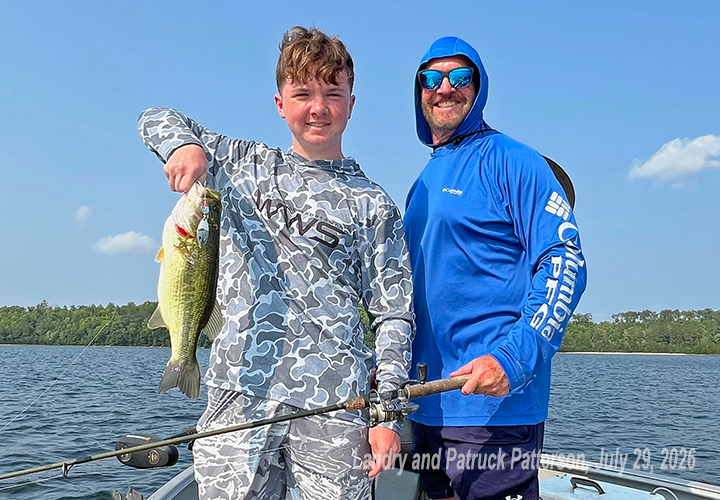
By days end, we’d enjoyed a full day of bass action, featuring spurts of good fishing, combined with lulls as I searched for “new territory”. The only thing that could have made it any better was to have Landry Patterson, Patrick’s son, pull in one nice bass. At about 5:00 PM, Landry cast a spinnerbait into a shallow patch of weeds and WHAM, hooked into a scrappy 17 incher, pictured here. That fish both achieved our goal and also marked the end of Patterson’s 2026 family fishing adventure.
The next trip, scheduled for July 2027 is already on the calendar and will bring us one year closer to the 40th anniversary of us all fishing together. That will happen, if all goes well, in the 2028 season. If I have anything to say about it, every day of those future trips will be just like the ones we enjoyed this season.  — Jeff Sundin, The Early Bird Fishing Guide Call-Text 218-245-9858 • Email • Facebook • X • Subscribe Insider Newsletter

 Ely Area, Arrowhead Outdoors Fishing Report July 29, 2026
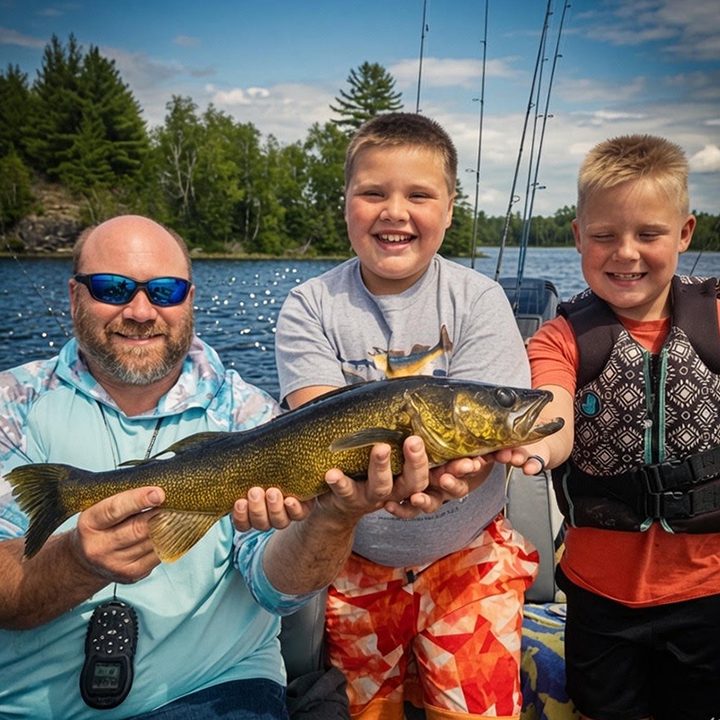 "Walleye fishing reports continue to reflect a classic, midsummer bite. While the shallow water bite has cooled off thanks to much needed rain and not needed lighting, anglers continue to find active walleyes in that 12 to 20 foot depth range. Where anglers are finding them seems to depend more on the angler than the fish.
Many anglers continue to find active walleyes working weedlines in that 12 to 15 foot range. For presentations, these anglers have been trolling gold, perch and purple colored spinner rigs tipped with a crawler or a leech.
Other anglers have been coming in with some really good reports about trolling deep diving crankbaits in that 15 to 20 feet of water. Shad, perch and white have been the best colors here. Anglers trolling have been focusing on large flats, rock piles or windy shorelines.
Smallmouth Bass also have settled into the classic midsummer pattern. What this means for anglers is that they should be looking for current areas, rocky flats in that 6 to 12 feet of water range and sunken islands in that 10 to 15 foot range. Anglers fishing rivers and shorelines have been throwing topwater baits (early in the mornings) chatterbaits, crankbaits, urchins and paddle tails to cover ground and find active fish. Anglers fishing out on sunken islands have been fishing with paddle tails on a heavy jig, drop shooting a split tail minnow and deep diving crankbaits.
Sunfish anglers continue to report great fishing for sunnies inside weedbeds, in that 4 to 8 feet of water range. These anglers continue to report the best fishing is coming when they are fishing with red worms or small leeches under a bobber here.
Crappie anglers have also been fish weedbeds looking for active crappies. With the rain and lighting has made this bite a little bit or miss day to day. One day anglers will find crappies sitting next to thick stands of cabbage, often on the shaded side of the stand. Here small jig/twister or paddle tails, dropped right next to the cabbage, get bit. During the last hour of light crappies have been breaking away from those areas and actually looking for minnows. When this happens beetle spins, jig/twister, jig/paddle tails, fished 1 to 2 feet under the surface has been getting it done.
Northern Pike anglers continue to find active pike in shallow weedbeds and around river mouths. While many of these pike remain under 32 inches, pike are less affected by this up and down weather pattern we are currently in. Anglers have been reporting aggressive pike hitting topwater frogs, mepps and large spoons." — Arrowhead Outdoors, 218-365-5358
 News Release July 2026 "MN DNR Seeks Public Input: Leech Lake Fisheries Management Plan"
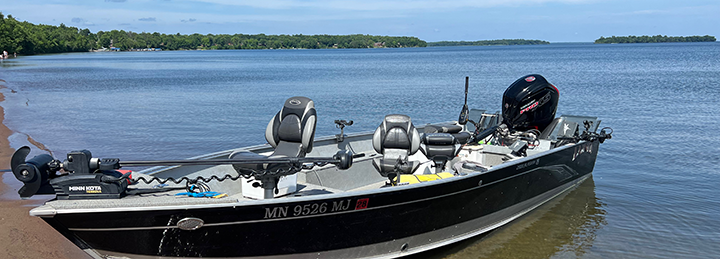 "The Minnesota Department of Natural Resources invites people interested in Leech Lake fisheries management to share their thoughts on a draft update of the fisheries management plan for the lake.
The Minnesota DNR last updated the Leech Lake Fisheries Management Plan in 2021, and in the new plan, the agency is aiming to reflect current public values and attitudes about how the lake should be managed.
“We’ve built upon the successes of the previous plan by providing updates and recommendations on proposed goals, objectives, and actions aimed at preserving a quality fishery in Leech Lake,” said Wade Massure, Minnesota DNR Walker area fisheries supervisor. “In the updated plan, we’re looking to continue that success with a focus on balancing predator-prey relationships in the lake and expanding primary and secondary management species.”
Balancing predator-prey relationships means maintaining adult walleye abundance at sustainable levels relative to the perch population, which is achieved through refinements in objectives and operational protocols. Expanding primary and secondary management species involves adding and refining objectives for muskellunge, northern pike, sunfish and crappie.
The updated master plan will be used to guide the management of Leech Lake fish populations. It will include management goals, objectives and actions for the lake for the next 10 years. If necessary, the updated plan will be evaluated and revised five years after adoption.
Review and comment on the Leech Lake Management Plan
The public can obtain a digital copy of the draft update on the Minnesota DNR Leech Lake management webpage. Comments on the draft plan may be provided by:
Using the online form on the Leech Lake management webpage.
Emailing walker.fisheries@state.mn.us.
Calling Walker area fisheries staff at 218-552-2330.
Mailing comments to 07316 State 371 NW, Walker, Minnesota 56484.
The Minnesota DNR is accepting comments on the draft plan beginning today, until 11:59 p.m. on Thursday, Aug. 20.
About Leech Lake
Leech Lake is a 112,000-acre lake and is the third largest lake located entirely within Minnesota. Leech Lake provides world-class angling opportunities year-round for walleye, yellow perch, muskellunge, northern pike, panfish, largemouth bass, smallmouth bass, among other popular species. Intensive monitoring of the fish populations occurs on an annual basis due to the popularity of this resource. More information about Leech Lake is available on the Minnesota DNR website."
Lake of the Woods Fishing Report July 28, 2026
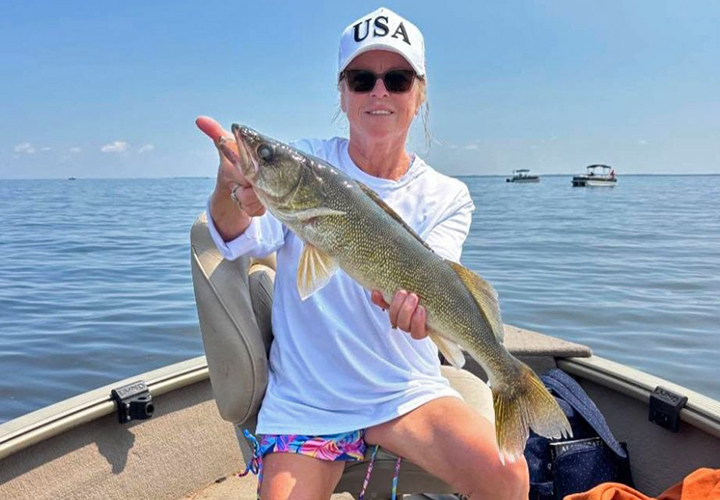 "Some anglers write off August as the "dog days" of summer when it comes to walleye fishing. A common theme on many bodies of water are weeds, warm water, deep fish and millions of minnows and young of the year fish that make it tough on walleye anglers. Lake of the Woods is a huge exception and walleye fishing continues to be excellent.
The summer patterns that have treated anglers so well are still firmly in place, and there are plenty of fish willing to cooperate. If a late-summer trip is on your mind, this is a great time to make it happen. Let's run through the three areas.
Big Traverse Bay (South Shore)
The deep mud is still the story on the south end. Big schools of walleyes and saugers are holding out over those flats, and the presentations that have carried the summer are as reliable as ever.
Drifting or slow-trolling spinners and crawlers behind a bottom bouncer remains the bread-and-butter approach for putting good numbers in the boat. Trolling crankbaits over the same deep water is producing nicely too, and it's a great way to cover ground and pick off active fish. In the stained water Lake of the Woods is known for, gold paired with a bright accent — pink, orange, chartreuse, or glow white — continues to be a winning combination. Between the two techniques, there's no shortage of ways to stay on fish through the day.
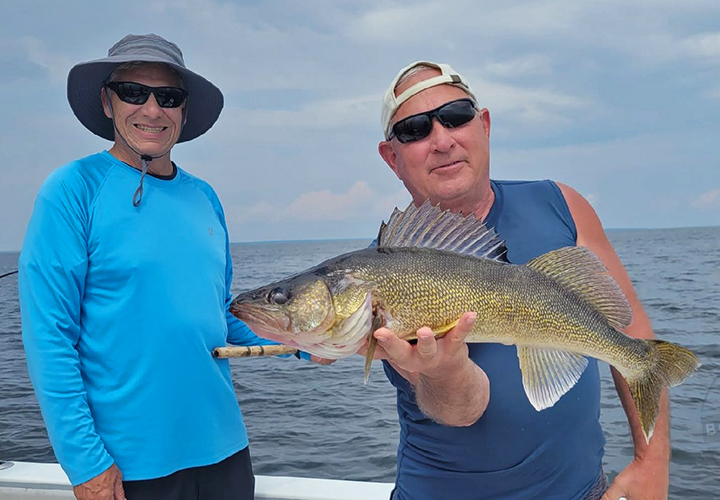 No disrespect to the jiggers, many are setting up over and on the edges of reefs as well as over deep mud and doing well. As long as you are on fish, vertical jigging with a minnow, leech or piece of crawler has been effective.
Rainy River
For anglers craving variety, the Rainy River is a place to consider. It's a genuine mixed bag this time of year, including resident walleyes that live in these forage-rich waters year-round, smallmouth bass holding on rock and current breaks, pike patrolling the bays, and the river's legendary sturgeon in the thick of their summer harvest season. Bring a range of tackle and stay ready, because you never quite know what will pull back next.
Northwest Angle
Up among the islands, the multispecies action is hard to beat. Walleyes lead the way, but the Angle is loaded with options such as big pike, muskies, smallmouth bass, jumbo perch, and crappies, all part of the daily mix. Fish continue to slide between the rock structure and the adjacent mud, so a little exploring goes a long way, and the next spot may well serve up a different species than the last. It's a paradise for anyone who likes to catch fish and keep the day interesting.
Before You Go
However you like to fish, your own boat, a guide, or a charter, the walleye bite is holding strong right through the heart of summer. Lodging and fishing opportunities around the lake are available for that August getaway." — Lake of the Woods Tourism, (800) 382-FISH
 Wired2Fish July 28, 2026 "Learning to Use Technology, and Understanding Crappies Better in the Process"
 "Don’t believe that adage about not being able to teach an old dog new tricks. Richard Bowling, a popular fishing guide at Truman Lake in Missouri, is a good example of how wrong that way of thinking can be. Bowling, a longtime guide on Truman Lake in Missouri, uses forward facing sonar to unravel some of the mysteries about crappie behavior.
After more than 30 years of guiding for crappies, he thought he had a good handle on what makes the species tick. Then live scope, which shows the real-time movement of fish, came along in the late 2010s. Even Bowling was amazed at everything he learned after that. Location, Location, Location
If it’s a crappie, it has to relate to brush, flooded timber, or weeds, right? Wrong. That was the old-school way of thinking. But Live scope has since revealed that crappies are quite comfortable living in ..." Read Full Story >> Learning to Use Technology, and Understanding Crappies Better in the Process
More Recent Fishing Reports
L.O.W 7-26 • Sundin Sunfish 7-26-26 • Goettl History 7-24 • Delicious Bowfin 7-22-26 • Sundin 7-16 • Lake of the Woods 7-16 • Ely MN 7-16 • Winnie 7-14 • Sundin 7-14 • Leech Lake 7-9 • Ely MN 7-8 • L.O.W. 7-8 • Sundin Report 7-1 • Grand Rapids 6-20 •
Follow on X • Follow on Facebook
July 26, 2026 "Summertime, Sunny-Time"
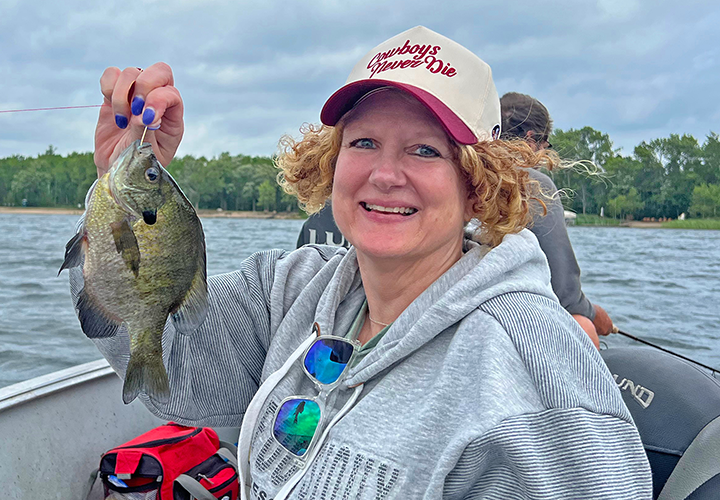 Summer heat is back, and while surface water temperatures remain lower than they were a couple weeks ago, they’re creeping back up. This weekend, for example, I’m seeing temps in the 75-to-76-degree range. As the waters warm, panfish, bass and crappies have become more responsive to trolling and faster moving presentations again.
Recall last Wednesday (7-22-26), when I reported catching bluegills using a vertical, jig and live bait presentation. That day, spinners helped me locate sunfish, but a nearly motionless presentation was needed to catch them in good numbers.
Move ahead to Friday (7-24-26), and an increase in water temperature from 74 to 76 degrees and sunfish, along with crappies and bass, were back into “active mode” striking spinners tipped with live bait aggressively. That day, ideal conditions, cloudy, breezy and warm, helped accentuate the trolling activity, so we’ll all have to take that into account on brighter, calmer days. That means showing up at the lake prepared with trolling gear but being prepared to switch into stealth mode when necessary.
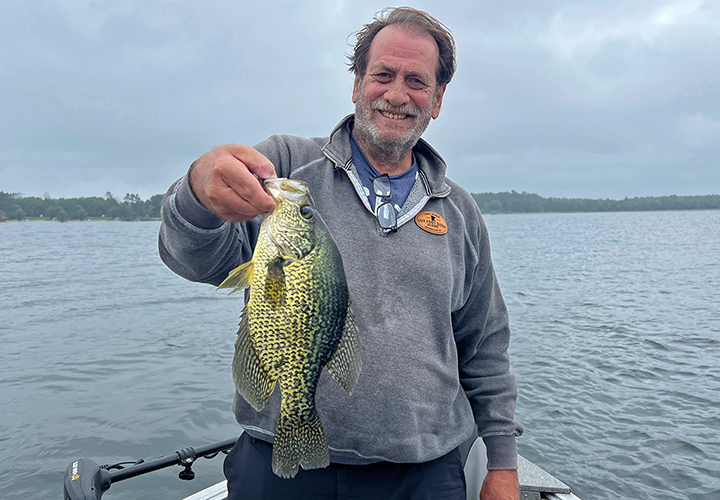 Some folks have said, okay Jeff, that’s great, but why won’t you just tell me where you’re catching these fish?
Well, there are several reasons for that, but the first, and most important, is that it doesn’t matter. That’s because wherever I go, and whomever I talk to, they all tell me the panfish bite is “on fire”. If you’re willing to do a little bit of research, you’ll discover lakes in your area that are productive. If a lake has a desirable mix of fish, you will be able to find them and catch them.
As a matter of fact, the 2 example lakes I highlighted above have similar habitats but are located 92.2 miles apart. That’s right, Last Wednesday, I was fishing east of Grand Rapids, and on Friday, we were fishing on the west side of Leech Lake. The habitats, mix of fish, and water clarity were the key factors, not their geographical locations.
Alright, I think folks headed for the lake today, or just arriving for resort vacations this week should focus on the shallow water, multi-species presentations. This is especially true on lakes where fishing deeper, for cooler water species like pike, muskies and walleyes could cause problems. I see that the MN DNR has issued a news release warning about the impacts of pursuing some of those fish.
ALERT "Minnesota DNR Reports Heightened Fish Mortality During Prolonged Heat" July 2026
"With hot summer weather creating stressful conditions for fish in lakes, rivers and streams across the state, the Minnesota Department of Natural Resources is sharing what people can do if they see a fish mortality event — and how they can help prevent them.
“We have been seeing chronically stressful conditions this summer for fish and are receiving continued reports of fish mortality events,” DNR Fish Health Supervisor Isaiah Tolo said. “People should be aware that they might see dead fish. We also want them to know what to do to report these events and what actions they can take to protect our fisheries.”
Current conditions and mortality events
Reports from the public, public utilities and fisheries staff have recorded surface water temperatures of 86 degrees Fahrenheit and higher in several Minnesota lakes and the Mississippi River. Cold water fish like lake cisco and other salmonids become stressed when water temperatures exceed 75 degrees and cool water species like northern pike can handle temperatures up to 84 degrees.
Fish mortality reports for 2026 so far include 212 reports spanning 102 waterbodies across the state, as far north as Lake of the Woods on the state’s northern border and as far south as Albert Lea on the southern border.
Among those reports, the Fish Health Laboratory received 65 reports for 29 waterbodies in a four-day period from July 16-20. Notably, fish are particularly susceptible to mortality in lake systems impaired by excessive nutrients, caused by urban and agricultural runoff. That’s because the conditions in these lake systems already pose a challenge for fish by accelerating decomposition and algae growth, and then are affected by low dissolved oxygen availability and warmer water temperatures.
The recent string of reports is the second of two "pulses" of elevated fish mortality events this summer. The first happened throughout June following rapid high temperatures after a colder winter and primarily affected lakes in the Twin Cities metro area. The current pulse is happening due to consistent high temperatures with little precipitation and is affecting a wider distribution of lakes across the state with varying levels of water quality.
A notable number of recent mortality events are affecting species that are sensitive to high temperatures. These include northern pike and muskellunge, cisco, and larger fish of all types because they have a smaller gill surface to body mass ratio compared with smaller fish. For example, several events report hundreds of dead northern pike with few other species affected. Dead and dying cisco have been reported on Lake Koronis in Stearns County. Large dead lake sturgeon have been washing ashore on Otter Tail Lake in Otter Tail County. The wide distribution of these events in the state indicates that fish populations across the state are experiencing similar conditions.
Water temperatures during Minnesota summers are increasing, and this summer is no exception. On average, according to climatology data, Minnesota lakes are about 3 to 4 degrees warmer and have lost an average of 10-14 days of ice cover in the last 50 years. The continued warming trends accelerate decomposition and algae growth. Research also indicates that summer fish kills are likely to increase with climate forecasts.
How to help
Minnesotans have a role to play in preserving and protecting the state’s fisheries. Anyone can report fish mortality events they observe on the Minnesota DNR website. This webpage also includes details about what can cause these events.
“Reports from members of the public are an important way we receive information about fish mortality,” said Tolo. “Those reports reach an interagency team of fish and water quality professionals.”
Homeowners and land managers
Those who own and manage waterfront property have an important role to play in protecting and restoring natural shorelines, which are important parts of good habitat for fish in their lakes. Promoting lake and stream-side tree cover and aquatic plants in lakes helps establish thermal refuges for fish. Information on natural shorelines and restoration is available on the DNR website. Riparian and non-riparian landowners alike can help reduce nutrient runoff into lakes and rivers, an important step in improving the overall resiliency of aquatic ecosystems. The Minnesota Pollution Control Agency has useful tips on preventing runoff, and restoration.
Fishing in hot weather
Anglers should be aware that fish are stressed due to warm water temperatures and low dissolved oxygen availability and are at a higher risk of experiencing angling mortality, which means fish are less likely to survive after being caught, handled and released.
Anglers should be cautious during heat waves, especially if they are targeting species sensitive to thermal stress such as pike, muskellunge and walleye. Avoid overhandling fish during these conditions.
More information about fish mortality events in general, as well as links to other resources and agencies involved in responding to these events, is on the Minnesota DNR website."
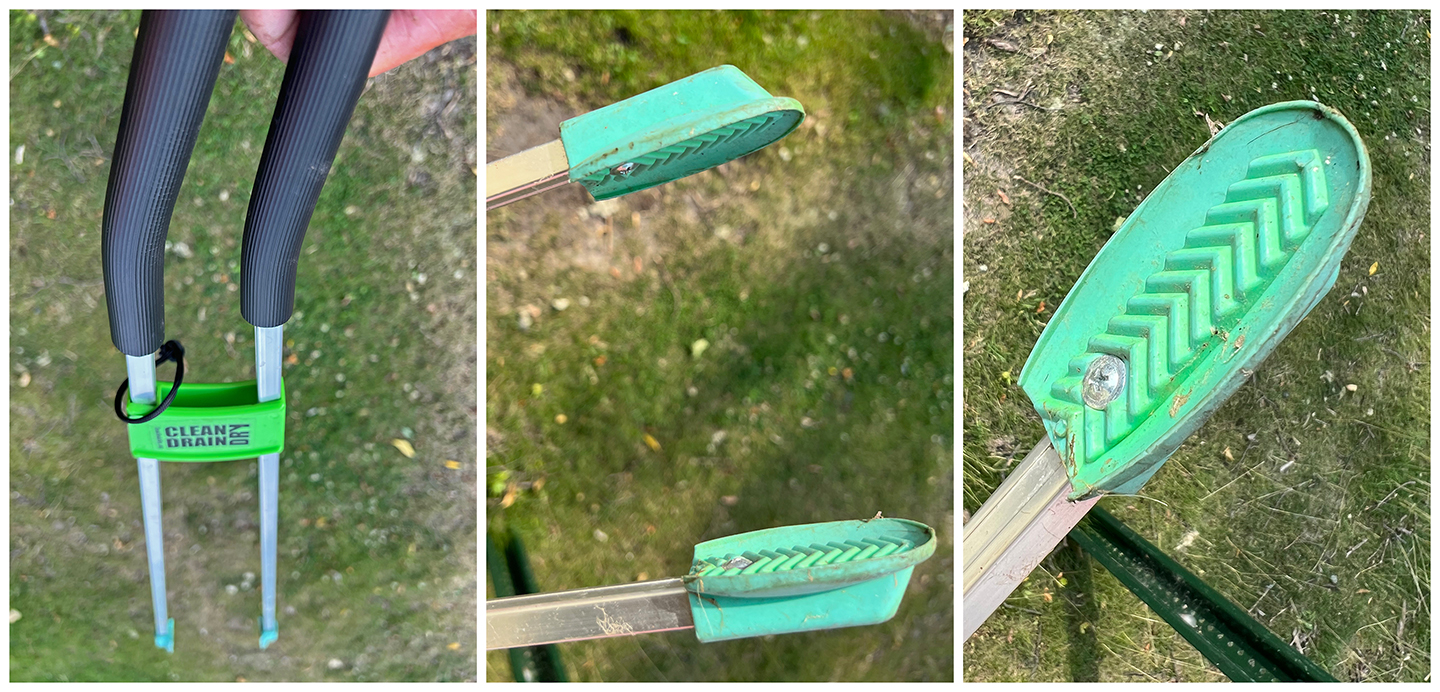 Where Can I Buy This Weed Picker? Sundin July 26, 2026
While we’re about warm weather, and summer habitats, let’s talk about weeds. This is the time of season when it’s nearly impossible to get off any lake without finding some weeds hanging off of the boat trailer. Try as we might, getting all of them off is difficult, even after being inspected by professionals, I’ve found weeds that all of us missed initially.
We all know that it’s on us boaters and anglers to make sure we’re not dragging invasive species from one lake to another. AIS Inspectors working at boat ramps do help spread awareness, and they do catch most of the hitchhikers and that helps. I’ve noticed though that there are less frequent inspections this summer than there have been in recent years. That’s fine for me because I already know my responsibilities and do try my best to make sure my boat is clean. But if I can make it easier, I would.
I’ve seen a tool that makes removing weeds from the under carriage of my boat and trailer. It’s a weed picker with a specialized, soft-rubber grip at the pincher end. These are by far the most effective picker tools I’ve used, and I would use one of them every day if I could. The problem is that they’re only available at certain boat ramps and I can’t find any retail source to buy one of my own.
I’ve reached out to AIS program directors in several counties, and received no response, let alone any help. I’ve talked with some individuals working as inspectors at boat ramps, but nobody there has been able to help either. Susan has researched the internet, using photos, brand names and even the UPC Bar Code, and has come up short too.
If you’re connected to anyone in the universe of weed removal tools and you know where I can buy one of these tools, PUH-LEEESE let me know. I’ll trade in all 4 of the pickers that I already have and replace them with this one. — Jeff Sundin, The Early Bird Fishing Guide Call-Text 218-245-9858 • Email • Facebook • X • Subscribe Insider Newsletter
July 24, 2026 "Recalling the Recall-Able"
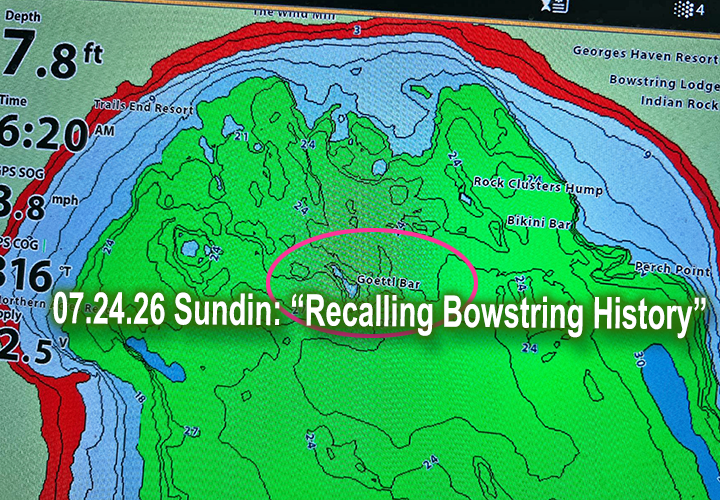 I wonder if you’ve ever fished on Bowstring Lake, just north of Deer River? Oh, you have, well then have you used the Lakemaster mapping chart while you fished there? Oh, you have, well then did you ever fish on the mid-lake structure called Goettl Bar? Well, if you have, then you might be interested to learn how that bar got its name.
The Goettl family has been fishing with me for a long time, near as I can recall, about 30 years, give or take. Back in those days, GPS, was in its infancy, we had the ability to “save a waypoint” and that was all. Viewing the structure on a map, like we do now with the aid of charting software, like the Lakemaster chip had not even been invented yet. GPS waypoints were nothing more than black dots on a blank screen. So, adding names to the fishing spots I’d saved on my GPS was crucial. Those names helped me recall details about the spots and why I’d added them to my waypoints.
Okay, one of those days, long, long ago, Erik and Phil, along with their friend Albert, were fishing with me in Bowstring. I remember struggling a bit, searching for fish, and moving a lot from one spot to another. While I was bouncing from spot-to-spot, my crew kept pointing out to me, a marker buoy fashioned out of an orange detergent bottle. To them, it was an open invitation to try the spot, but for me, it seemed like cheating to fish a place that somebody else had marked in that way. So, I resisted my crew’s kibitzing, trying every other spot except that one.
You might see where this is going, my struggles continued and eventually, I gave in to my crew and motored over to the orange jug. Albert, tossing in a ¼ ounce jig head tipped with a shiner said, “there’s one” and reeled in a nice keeper walleye. Soon, Phil and Erik added walleyes to the larder, and not long afterward, my crew rejoiced in the “see I told you so” chant. I took the teasing like a man, smiled at my crew and pronounced that the Goettl family would be forever immortalized on my personal GPS spot-list. That’s where the name Goettl (GET-ELL) Bar came from.
 Not long after that, I was working with the Lakemaps company and was asked to help create a rudimentary paper map of Bowstring with a handful of GPS coordinates. That’s when names like Goettl, Finch, Bikini and other bars first appeared in print. They were all waypoints that I’d named to help me remember what those black dots on my blank grey GPS screen there were for.
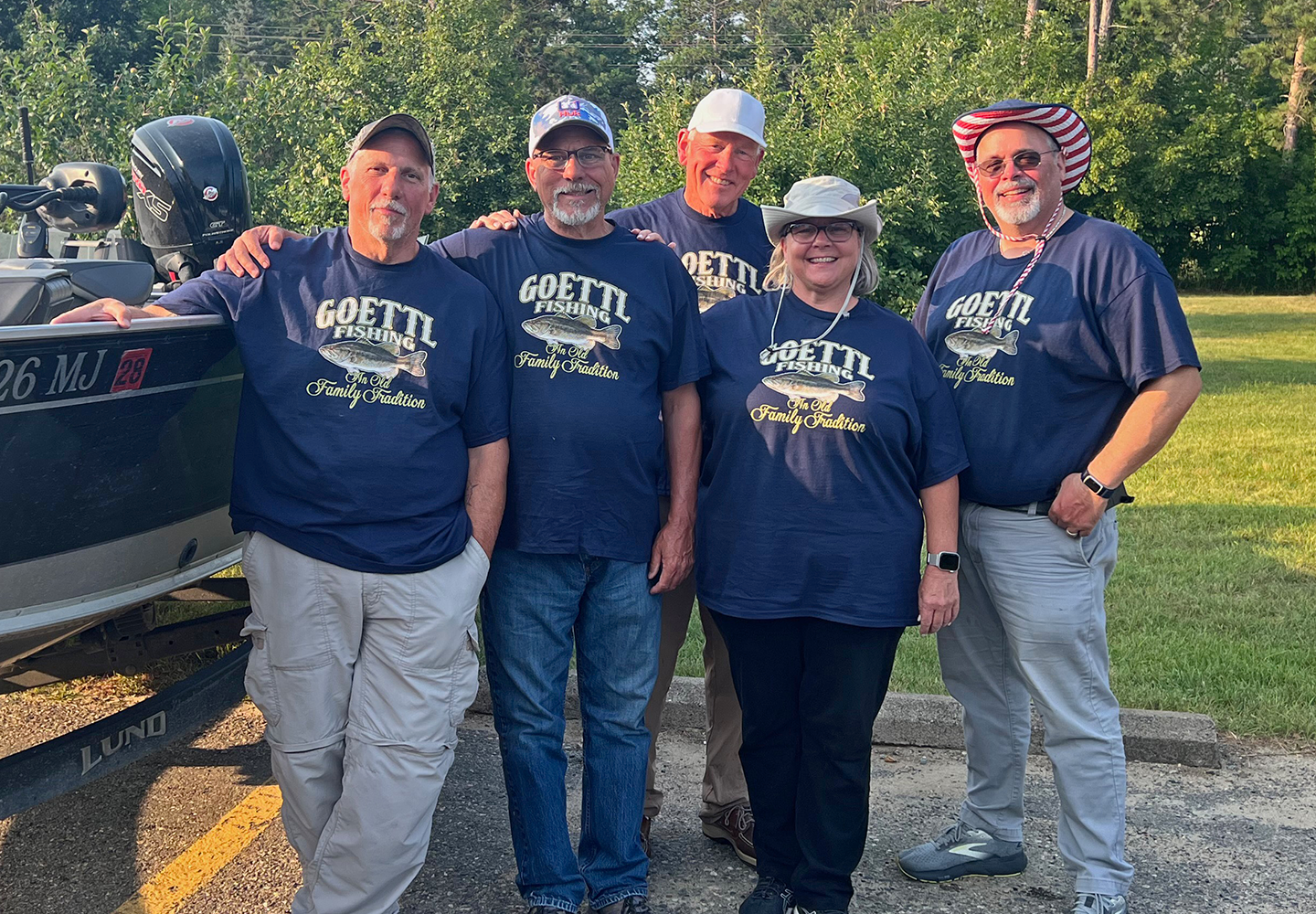
We were missing Ed, aka “Grampy” but most of the Goettl family were here this week, and we’ve been fishing together for the past 3 days. Pictured in front are Phil, Erik, and Kristin, the Goettl siblings, along with Al Pietras, Kristin’s husband. In the back, it is I, a humble and honorary member of as it says on the t-shirts, the “Goettl Family Old Family Tradition.”
The fishing happened on 3 different lakes, but the fishing reports from all 3 are very similar. On day 1, lake 1, we trolled spinners on the weed edges and caught a mixed bag of crappies and sunfish. On that lake, water temperatures ranged from 77 to 79 degrees and fish were active. Trolling provided all the action we needed, and no other presentations were tried. We did not harvest limits of anything, but we had respectable totals, about 17 sunfish and 25 crappies total.
On day 2, lake 2, we trolled spinners on the weed edges but largely failed with that presentation. Water temperatures were cool, ranging from 73 to 74 degrees and fish were mostly inactive. Walleyes, our target species were tough to come by, we caught 1 keeper, and 1 small fish that was released.
On that day, we caught a couple of sunfish while we were trolling. Spinners were good enough to find the sunfish, but not good enough to catch them. Once located, I stopped, and re-rigged the crew with 1/8 ounce live bait jigs and tipped them with cut pieces of night crawlers. We fished vertically, keeping our jigs hovering just above the weed tops and that changed saved the day. Again, we did not amass limits, but by days end, had a very impressive catch of nice size sunnies. Even if they weren’t walleyes, they’d provided a lot of action, and plenty of protein for the family.
On day 3, Lake 3, walleye fishing was somewhat better. With surface temperatures holding steady at 74 degrees, walleye, pike and perch were “semi-active”. Trolling spinners, some tipped with minnows, some tipped with crawlers, we managed to harvest 19 keepers, still 5 fish short of the 4-person limit, but again, a very respectable catch. Those walleyes, along with a dozen nice perch and a few keeper northerns rounded out the 3 day catch nicely.
All of the fish we caught on the last trip were found holding tight to the edges of cabbage patches in shallow water. Key depths varied, but 7 to 9 feet deep was the best range overall. Trolling speeds varied too, ranging between 1.1 and 1.5 MPH, the sweet spot was 1.2 MPH.
Today, action is the plan, walleyes are not our primary goal, but we’d be happy catching a few. So, I’m headed for a small, acre lake that has almost every species available in north central Minnesota. I’m hoping for a mix of crappies, sunfish and bass, and with luck, a few bonus walleyes. I’ll have an update available, most likely on Sunday morning. — Jeff Sundin, The Early Bird Fishing Guide Call-Text 218-245-9858 • Email • Facebook • X • Subscribe Insider Newsletter
Lake of the Woods Fishing Report July 23, 2026
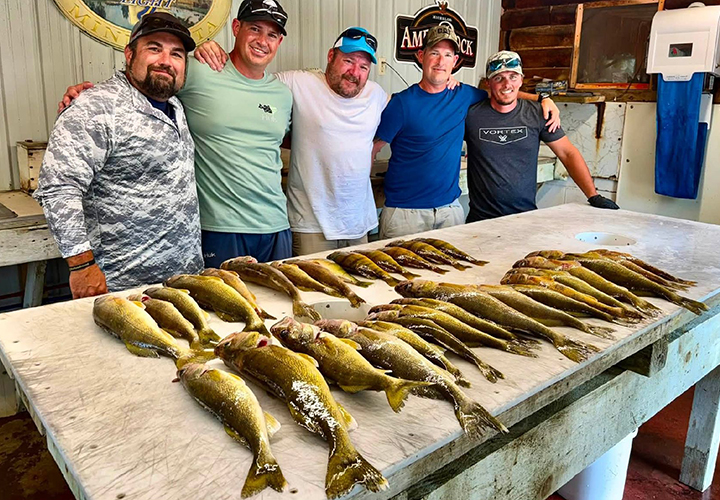 "Fishing has been very good on Lake of the Woods, and the numbers tell the story. Some years, anglers have to sift through small walleyes and saugers to put eaters in the box. Lately it's the opposite problem, to find their eaters, anglers are sorting through protected slot fish in the 19.5 to 28.0 inch range. With an occasional trophy over 28 inches, it's an entertaining "problem" to have!
On Big Traverse Bay (south shore), spinners and night crawlers over the deep mud have emerged as the standout tactic for catching numbers of fish. The setup is simple and effective: Run a 2- to 3-ounce bottom bouncer or weight ahead of a two-hook crawler harness that incorporates a snelled spinner. Your crawler harness is tipped with a full nightcrawler hooked at the nose, and in the center, leaving a few inches of crawler trailing off the back hook, trim the worm close to to back hook. The fish will still hit it, and you'll turn more of those bites into hookups.
For colors, hammered gold, hammered copper, gold/orange, straight orange, and gold/pink have all been getting it done.
Crankbaits are worth keeping rigged up as well, and a number of anglers are trolling them with good success. With so many fish stacked over the deep mud in 30 to 38 feet of water, putting something that looks like an injured minnow in front of a walleye is awfully hard to beat. Between the two approaches, there's plenty of opportunity to stay on active fish all day.
The Rainy River is serving up a true mixed bag right now, which is exactly what makes it such a fun change of pace. Resident walleyes call these forage-rich waters home year-round, and alongside them you'll find smallmouth bass tucked into the rock and current breaks, pike prowling the back bays, and the river's famous sturgeon, the largest freshwater fish most anglers will ever tangle with, now in their summer harvest season.
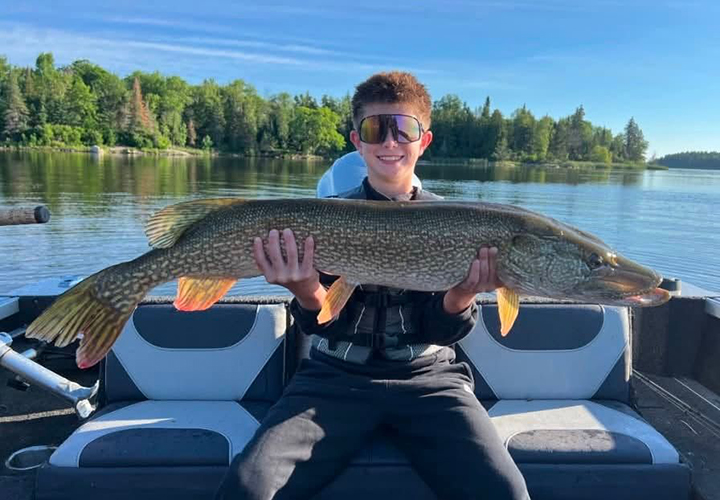 The river is beautiful in the summer months and doesn't see many anglers. It's a nice option or perhaps an addition to fishing on the lake.
The Northwest Angle continues to deliver outstanding multispecies action. It's a beautiful area where the lake's 14,552 islands begin, and it is loaded with fish.
Walleyes are the headliner, naturally, but big pike, muskies, smallmouth bass, jumbo perch, and crappies are all in the mix among the islands. With endless structure to explore and fish sliding between the reefs and the nearby mud, it's the kind of place where the next spot can produce a completely different fish than the last one. For an angler who loves a little of everything, it's tough to top.
There isn't a lot of big water in these parts. The islands break up the big water, making it feel more like a number of small lakes versus one large body of water. Fishing is world class!
A quick reminder on the regulations, since you'll be handling plenty of fish this week: the combined walleye and sauger limit is 6 fish total, with up to 4 being walleyes. All walleyes between 19.5 and 28.0 inches must be released immediately, with one walleye over 28.0 inches allowed in posession. A 2026 Minnesota fishing license is required.
Whether you bring your own boat, book a guide, or step aboard a charter, the summer walleye bite is as consistent as it gets right now. Lodging and fishing opportunities around the lake are available for that summer getaway." — Lake of the Woods Tourism, (800) 382-FISH
Wired2Fish July 23, 2026 "Five Unique Hollow-Body Baits That Get Big Bass Blowups"
 "Hollow-body frogs are some of the best big-bite getters on the market. But it’s easy to forget that frogs are only one segment of this bait genre.
Today’s lure manufacturers are combining modern technology with the tried-and-true concept of a hollow-body bait to make some really interesting stuff. From bluegill baits laid on their sides to spiders and more, there are some wild baits out there now. I decided to grab a few and try them out — and, in the process, found five weird lures that get big blowups.
Of what I tested, I was most excited to try this bait. I couldn’t help but think about Aaron Martens winning the Elite on Lake Havasu years ago, targeting fish around the ..." Read Full Story >> Five Unique Hollow-Body Baits That Get Big Bass Blowups
July 22, 2026 "Revealing the Reveal-Able"
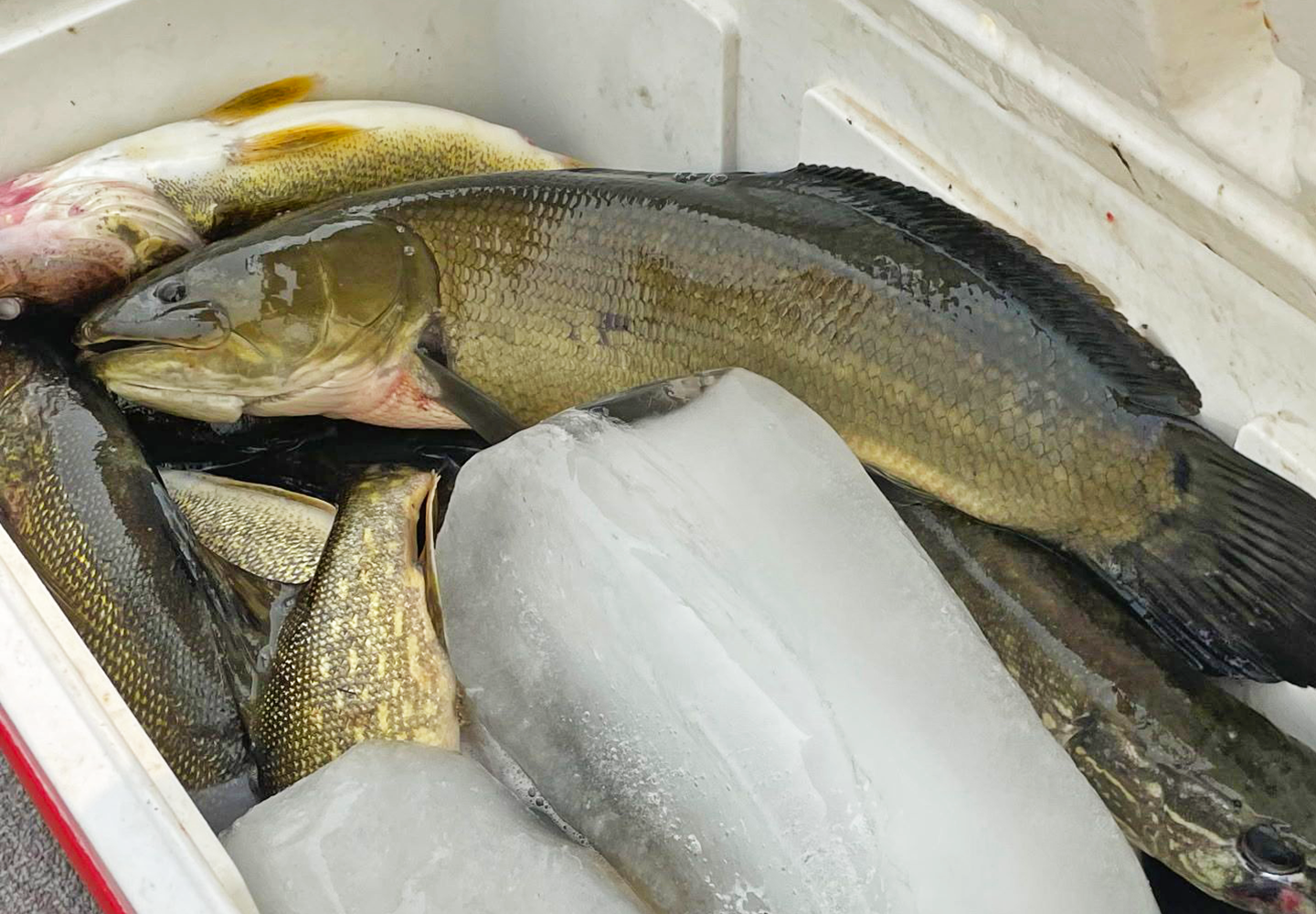 Yesterday, I left you with a brain teaser about which "special" species of fish Ben White caught and harvested for the family fish fry last week. Ben requested that his grandpa, Bill, prepare the fish. The review of the meal, posted yesterday, by Marc White referred to this, the Bowfin, aka Dogfish, that I filleted for the young lad.
Just look at the smile on that fish’s face, I think it was thrilled that finally, somebody was willing to help it fulfill its life destiny. Okay, that might be a stretch, but seriously, after reading Marc’s review of the meal that the fish provided, I’ll have to at least give more consideration to harvesting some of them in the future.
If you’ve ever caught a bowfin, then you already know that they are one of the strongest fighting fish that swims in fresh water. In fact, I was amazed that 11 year old Ben had the strength to hold that fish for this photo.
What you may not know, and I certainly didn’t, is that the bowfin has a lineage dating back to prehistoric times. In fact, the bowfin, according to Encyclopedia Britannica is a "living fossil," originating from a lineage of primitive bony fishes that first appeared over 250 million years ago during the Early Triassic. Britanica, “Bowfins belong to the order Amiiformes and are part of the infraclass Holostei, which also includes gars. They are the only surviving members of the family Amiidae, a lineage that dates back to the Jurassic Period (201–145 million years ago), making them one of the most ancient freshwater fish lineages still extant today.”
Maybe, even if we don’t set our sights on a bowfin fish fry, we should at least give these hard-fighting, prehistoric fish a little more respect; I know I will.
Before I run, I’ll leave you today with a brief update about fishing conditions that we encountered on Tuesday.
Windy, cool conditions persisted and so did the “mix-over” that I described yesterday. Surface water temperatures dropped from the low 80s into the 78-degree range. Sunfish, crappies and bass seemed unaffected by the cooler temperatures, at least in terms of their willingness to strike. Walleyes on the other hand were non-existent for us.
I’m not sure that I can say walleyes weren’t biting, they may have been. Panfish, especially sunfish, were so active, and striking so violently that our baits never made it down to where the walleyes were living. It’s possible, maybe even likely, that a day when the panfish bite was “off” could provide a great opportunity to catch walleyes.
Be that as it may, our day turning out to be a panfish slugfest was far from disappointment. By days end, we came close to capturing 20, a 4-person limit of sunfish, 17 I think was the total. Crappies were more plentiful than our total count would suggest, that’s because we were fairly selective about which ones we harvested. If we had settled for 9-3/4-inch fish, my 4-person crew would have easily filled their bag limits. By insisting that all fish needed to measure 10 inches or larger, we wound up with 27 or 28, about a dozen short of their full limits.
Today, I have the same crew, and again tomorrow too. We’re going to try and step up our walleye game today, and with luck, still bag a mix of perch or panfish at the same time. Tomorrow, I’ll offer guidance about if, and how that plan works out. — Jeff Sundin, The Early Bird Fishing Guide Call-Text 218-245-9858 • Email • Facebook • X • Subscribe Insider Newsletter
Ely Area, Arrowhead Outdoors Fishing Report July 22, 2026
 "Walleye fishing reports continue to be on the good to excellent side for many walleye anglers right now. Anglers continue to report that they are finding walleyes shallow, in that 6 to 8 feet of water. Key locations are either over shallow rocks or in weedbeds.
Many of these anglers have been slip bobbering using a leech, pitching a jig with half a crawler or swimming paddle tails over these shallow rocks and weedbeds. If you're not finding them in shallows be sure to check weedlines in that 12 to 16 feet of water. Gold, orange and perch colored spinner rigs, tipped with either a leech or a crawler has also been very effective. Growing number of anglers are starting to find success trolling large crankbaits in that 15 to 30 feet of water. These anglers have been trolling over large flats looking for active walleye.
Smallmouth bass continue to be found just about everywhere right now. Large shallow rocky flats, rivers, downed timber, on and suspected just off sunken islands are all holding aggressive smallies right now. Anglers continue to catch them with topwater baits, urchin baits, chatterbaits, wacky worms, crankbaits and in-line spinners in that 6 to 15 feet of water right now.
Panfish - Crappies and sunfish continue to be easy to locate and easy to catch for many anglers right now. The best fishing for both species continues to be right in the thickest weedbeds you can find.
Crappies have been hanging around the thickest clumps of cabbage, often time on the shady side of the cabbage. Fishing with a 1/16oz jig, tipped with a 2 inch twister and dropped in that shade is really producing crappies. During that last hour of light those same crappies start moving around those weedbeds looking for a easy meal. This is when swimming beetle spins, jig/twister and even small paddle tails, about 1 to 2 feet below the surface is very effective. If you can't find thick cabbage beds, downed trees also will hold crappies during the day.
Sunfish anglers too have been finding sunfish in thick weedbeds and in pencil reeds. Small red worms or small leech's, fished under a bobber has been lights out.
Northern Pike anglers continue to find lots of active pike patrolling weed lines and river mouths. Many anglers have been trolling large spoons, covering ground, looking for biters. Brighter the color of the spoon, the better. Anglers that prefer to cast for pike have been throwing spoons and large swim baits in these same areas." — Arrowhead Outdoors, 218-365-5358
July 21, 2026 "Mixing the Mix-Able"
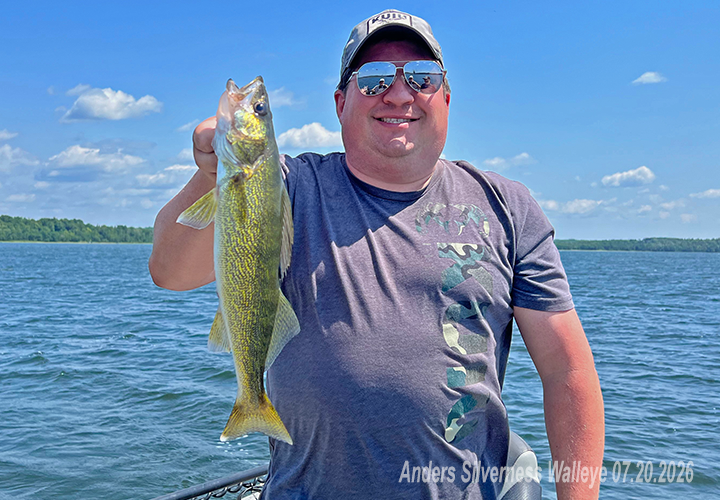 The heat wave, broken by Monday’s gusty west winds, and cooler temperatures, lost its grip on north central Minnesota. Weekend surface temperatures registering at 81-to-84-degrees began falling and settled in at either side of the 80 degrees mark. The mixing affect caused by the turbulence is tantamount to what we refer to as a “turnover”.
But Jeff, you could be thinking, turnover only happens in the fall, when surface water cools into the low 40s, there’s no way that a 4 degree drop from 83 to 79 degrees can cause a turnover, right? Well, technically you’d be both right and wrong at the same time.
THE turnover, the full-scale thermal inversion that occurs during late fall is entirely different than one of these “mini turnovers” that occur during mid-summer. Maybe a better way to describe what happened yesterday could be to use the term “Mix-Over”.
With enough wind, the shallow water zone, the zone from about 0 to 15 feet deep, is churned by whitecaps. The rolling waves cause current, and the current begins mixing the water. After several hours, the temperature and oxygen levels equalize. To the fish, water quality is essentially the same from top to bottom. Now they can go wherever they like, and feed on the smorgasbord of minnows, insects and small gamefish that abound during the summer peak.
I can’t say that I’m a fan of the super-hot weather we experienced last week, but it was working for me. Last week, hot and calm weather forced fish into the heaviest patches of weeds we could find. In some cases, cabbage that grew right up to the water’s surface held the best fish. We literally had to grind through patches of weeds, pulling fish out of the shadows, persuading them up and over the heavy cover. If I moved away from the weeds, even a little bit, our action ground to a halt. The pattern made fish locations predictable, and for me, productivity was vastly improved.
What my crew and I discovered yesterday (Monday 7-20-26) was that fish were still active, only now they were scattered. The fish we caught, a mix of crappies, sunfish, rock bass, small perch and a walleye, were all random catches. There was literally no way to predict which one would bite at any given time. I could no longer pinpoint the precise locations of fish, but if I stayed near the weeds, we could expect that something would happen. Productivity measured in our hourly catch rate declined, and we had to work more, and be happy with less.
Today, strong north winds are predicted to continue, and the temperature will be even cooler. The impact of the “Mix-Over” will continue and I anticipate, so will the randomness of fish locations. I expect that fishing the mixed bag trolling patterns will work, but maybe not as well as it did a week ago. If I locate a desirable school of fish, I might need to modify the presentations I use to take advantage of the conditions.
I’ll know a lot more tomorrow than I do now, so I’ll skip talking about presentations and locations until then.
Before I head out, let me leave you with a brain teaser for tomorrow morning. I’ll reveal the identity of a special fish we caught last week, but I want to give you a chance to guess what it was first. So, today, consider this statement from Marc White, one of the Arbogast family fishing group that was here last week.
White, “First off, thanks again for a great week of fishing. Bill (Arbogast) had mentioned you wanted feedback on the “special fish” that Ben caught.”
“When it was fresh fried, we thought that it had the consistency and taste of processed chicken breast patties. We had some leftovers and when I reheated them the next day, consistency of the fillet was the same, but I thought the flavor changed a little bit. That day I thought it tasted like a mild catfish filet. It was good and tasty; I enjoyed it! Thanks again. Marc”
Okay, you think that one over, and I’ll try to figure out where to catch some fish today. See you here again tomorrow morning. — Jeff Sundin, The Early Bird Fishing Guide Call-Text 218-245-9858 • Email • Facebook • X • Subscribe Insider Newsletter
July 16, 2026 "Fishing The Dog Days, And Loving It!"
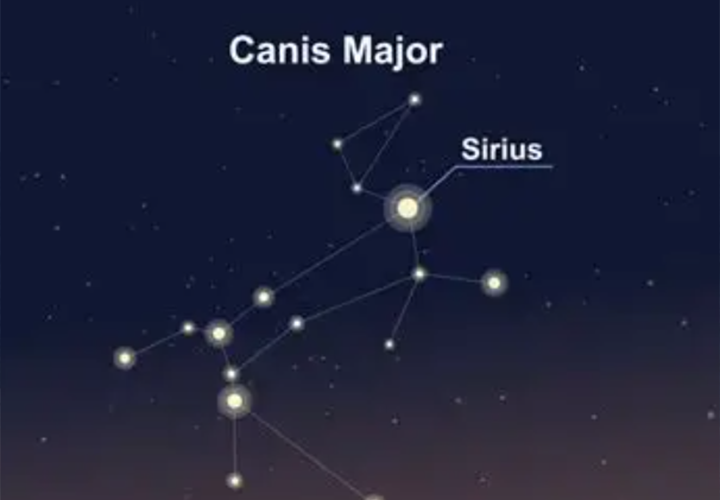 My own fishing customers have heard me say this already, but I’m not sure if I’ve written it before. I think one of the best times to fish in Minnesota is during the “dog days” of summer. Under the rising influence of Sirius, “the Dog Star” these 4 to 5 weeks of hot weather represent many of my best fishing charters of the season.
I remember a time when I wouldn’t have said that, but that’s because decades ago, I didn’t know what I didn’t know. Take bug hatches for example, many of us used to believe that insect hatches represented the end of good fishing. Even today, many anglers hear the words, and skip going to the lake because they believe that fish won’t be biting during a bug hatch.
 That’s too bad because nowadays many know that insect hatches represent opportunity, not catastrophe. Yes, it’s true, anyone who braves the heat, and cracks the code of where fish are located during a bug hatch will be rewarded with good fishing. Whenever we see mature mayfly, midge, or caddis flies on the water’s surface we should train ourselves to immediately ponder the first step in cracking that code. Our thoughts should turn to pinpointing the source location of the larvae that’s maturing into those adult stage flying bugs.
The larvae itself may not be in the same places where we find the mature flies. As the larvae matures and rises to the surface, any water current, breeze or even the insect’s own flight pattern will relocate them. So, we need to back up and search for larvae that has not yet fully developed. It will appear as “clouds” or “waves” of tiny, grainy looking specks on your graph. As you see pictured here, fish may be visible hovering in and around the clouds of larvae.
In this case, the fish were walleyes and they were part of the food chain that developed around developing mayfly larvae. Locating mayfly larvae isn’t too complicated because they can be found over soft-bottom areas on flats in open water. Sometimes though, finding insect larvae takes more investigation, or is discovered in other ways.
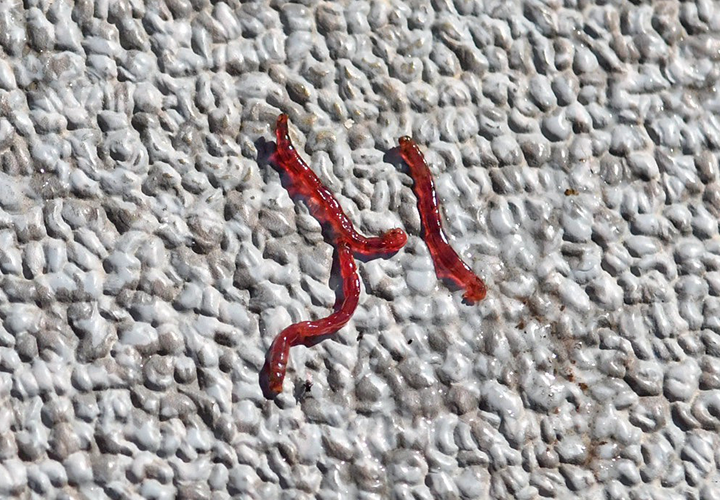 In this image, blood worms were discovered inside the mouth of a small northern pike. They were not visible on my graph because the water was shallow, and there was vegetation to disguise the nymphs. But once I knew about the midge hatch, I was able to zero in on some nice size perch that were feeding on the bloodworms, one of their preferred foods.
I’m up against the clock this morning and not able to devote adequate time to the subject. I promise to come up with more information as time allows in the coming days.
For now, let me leave you with this thought. If you are willing to brave the heat, and also willing to accept a mixed bag catch, you should plan to fish soon, like right away! Water temperatures are warm, over 80 degrees, fish metabolism is high and the action has been good. Depending on where I find them, every species of fish has been active and catch-able. Warm water species like bass, sunfish and crappies have been particularly good. But walleye and pike are moving too, and while the numbers vary day-to-day, we are catching enough of them to keep the pursuit interesting. — Jeff Sundin, The Early Bird Fishing Guide Call-Text 218-245-9858 • Email • Facebook • X • Subscribe Insider Newsletter
Ely Area, Arrowhead Outdoors Fishing Report July 15, 2026
 "Walleye anglers continue to report good fishing this last week despite hot air temperatures. Many anglers reported finding walleyes in 6 to 8 feet of water range, even during the middle of the day. Some anglers reported finding them right in weedbeds, while other anglers found them over shallow rock piles or rocky points.
Fishing areas with a little bit of a chop on the water really was the key to finding shallow water walleyes. More often than not these anglers were throwing jerk baits, jig/half a crawler, slip bobber and leech or paddle tails to catch these shallow walleyes. Many other anglers reported finding walleye out on and around sunken islands in that 15 to 20 foot of water range. These anglers have mainly been slow trolling orange, gold or perch colored spinner rigs, tipped with either a leech or a crawler. Leeches continue to out produce crawlers this last week.
Smallmouth Bass have largely set up in their summer patterns now. What this means for anglers is that you can pretty much find them everywhere right now. Shallow rocky flats, downed trees, rivers, sunken islands, all are holding bass right now. Anglers have been catching bass on just about everything too. Wacky worms, top water, chatterbaits, square bill crankbaits, paddle tails, spinnerbaits and in-line spinners are all producing good numbers of bass. Depth range remains in that 6 to 15 feet of water.
Panfish anglers continue to enjoy great panfish fishing right now as water temperatures warm up to temperatures they enjoy. Crappie and sunnies are settling in nicely to their summer patterns. Sunfish anglers have been finding the best fishing deep inside pencil reeds and weedbeds this last week, with red worms fished under a bobber. Small beetle spins also produced good numbers of sunnies too. Anglers targeting crappies this last week continue to report the best crappie fishing taking place during the evening hours. Anglers have simply been swimming small paddle tails, jig/twister, beetle spins and even small crankbaits, about 1 to 2 feet below the surface, in 6 to 12 feet of water.
Interest in northern pike fishing has really slowed this last week as the average size of pike continues to drop. Small pike continued to be active hitting large spoons and swim baits. Weed lines in that 8 to 15 foot depth range were very productive as were river mouths.
Stream Trout - Anglers continue to enjoy easy fishing for active rainbows this last week. Although water temperatures increased, thus pushing stream trout down deep, anglers continued catching trout. Majority of trout caught have been in that 15 to 40 feet of water range now. Cowbells trolled with a small spoon or brightly colored crankbait, continue to produce trout." — Arrowhead Outdoors, 218-365-5358
Lake of the Woods Fishing Report July 15, 2026
 "The summer patterns continue with great success on Lake of the Woods. The hot weather has the walleyes fired up and eating, and coolers are being filled with walleyes and saugers across the system. Three techniques are dominating right now, spinners and crawlers, jigging, and trolling crankbaits. Hot colors remain gold paired with brighter shades such as pink, chartreuse, orange, glow white, or a combination of these. Here's where things stand across the three areas this week.
Big Traverse Bay, South Shore, L.O.W
The big schools of walleyes and saugers are out over the deep mud, and all three of the go-to presentations are producing. Spinners and crawlers, jigging, and trolling crankbaits will each put fish in the boat. Oftentimes, it's just a matter of matching the method to how the fish are set up on a given day.
Crankbaits deserve a closer look this week. Both shad-style baits and the thinner minnow-style baits are doing well, so don't be afraid to alternate cranks until you find what the walleyes want that day. A lot of little factors go into that choice: Is it sunny or cloudy? What forage is prevalent in this part of the lake? Is the water stirred up or clean? All of these matter, and they can change from one day to the next.
 It also pays to experiment with speed. This time of year, 2.2 to 3.0 mph is a good bet. And think about where you're positioning the crankbait in the water column. Sometimes, they want it right in their face, and other times it's better to run it above the fish and make them chase. Small adjustments like these often turn a slow stretch into a good one.
The Rainy River
The Rainy River continues to offer up a nice mixed bag. The walleyes here don't stack up the way they do during the spring and fall runs, but there's a strong resident population that lives in these forage-rich waters year-round, and the same summer presentations working out on the lake translate well to the river.
The sturgeon harvest season is underway too, and these prehistoric giants remain one of the river's biggest draws — in most cases the largest freshwater fish an angler will ever catch. Smallmouth bass round out the mix around rock, current breaks, and shoreline structure.
Northwest Angle L.O.W Region
Up at the Angle, there's endless structure and plenty of fish, so there are always walleyes relating to the rocks and reefs. As with the south end, though, many walleyes have slid off that structure and out over the adjacent mud, where the same spinner, jig, and crankbait programs are getting it done. It remains a true multispecies destination, with walleyes, saugers, pike, jumbo perch, and smallmouth all in the mix. In addition, the muskie fishing is in full swing on some of the best water in the nation.
Lake of the Woods absolutely shines this time of year. While many bodies of water struggle to produce consistent walleye catches through July and August, the fishing here stays strong right through the heat of summer. It's a great time to show the kids, or someone who doesn't fish much, some quality walleye action by stepping aboard a charter or hopping in with a guide. All guides on Lake of the Woods and the Rainy River are licensed charter captains, and they're among the most talented in the walleye belt. All fishing equipment, bait, and fish cleaning is provided, so all you have to do is show up and enjoy the day. Lodging and fishing opportunities around the lake are available.
A quick reminder on the regulations: the combined walleye and sauger posession limit is 6 fish total, with up to 4 being walleyes. All walleyes between 19.5 and 28.0 inches must be released immediately, one walleye over 28.0 inches allowed in posession. A 2026 Minnesota fishing license is required." — Lake of the Woods Tourism, (800) 382-FISH
 Lake Winnie Cutfoot Sioux Fishing Report July 14, 2026
 "After several seasons of relatively easy walleye fishing, anglers are working harder, and smarter to capture “The Gold” on Lake Winnie this year. Declines in the population of fish from strong 2018- and 2019-year classes account for part of the struggle. This year though, unfavorable environmental conditions have accounted for more than the fish populations have.
Jake Premo, one Lake Winnie's better fishing guides said yesterday, “Right now, practically every piece of structure on that lake has at least some walleyes on it. It’s crazy, even when I stay 40 to 60 feet away from the fish, I can scan them and get about 1 out of 15 fish bite using jigging raps or using slip floats and live bait.” Premo went on to say that there are fish in shallow water too, they are visible, but like their deep-water cousins, are very difficult to catch.
Turning to advanced electronics to help solve the problem worked like a charm for several seasons. Without doubt, the proper use of forward-facing sonar will allow you to see fish before your boat passes over them and that is a big advantage. Still, seeing fish on your screen doesn’t mean that you can ..." Read >> Bowen Lodge, Lake Winnie July 14, 2026 Fishing Report
July 14, 2026 "Locating the Locate-Able"
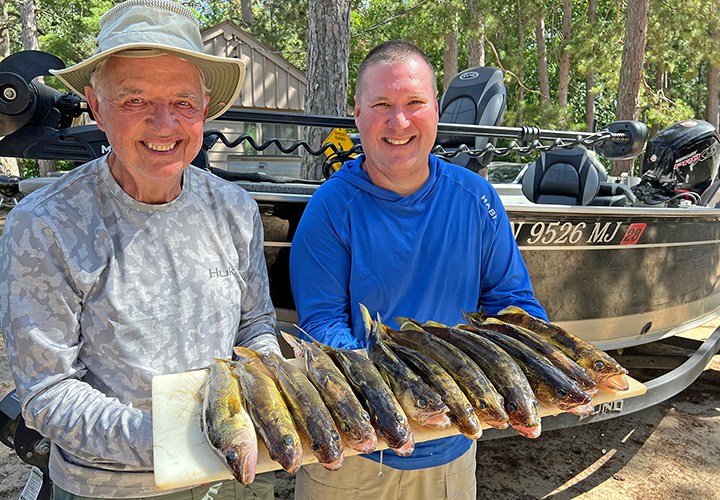 In north central Minnesota, surface waters are very warm! The hot weather and sunshine have hyper charged them and finding 81-to-82-degree readings is now the norm, not the exception. Weed development is on the fast track too, and tall stands of lush greenery are well established.
With all this warm water, and hot weather, one would imagine that algae blooms had followed suit. They really haven’t though and I think it’s because of the low water levels in our region. Without runoff entering lakes from low-lying areas and small, fertile feeder streams, lake water has remained unseasonably clear. How that impacts fish location appears to be split, varying by specific lake types.
On Sunday, I fished at a western Itasca area lake that has a mix of fish species, and lots of shallow weed cover types. Under the sunny skies, I would have thought finding fish in the vegetation should have been easy, but it wasn’t. On that lake, fish had responded to the sunshine by moving deeper, into 20 to 24 feet of water, holding just above that lake’s well-developed thermocline. During morning, those fish, a mix of walleye, crappies and sunfish were willing to strike. As the day wore on, calm seas and harsh sunlight forced the bite to slow, but the fish stayed in those areas.
On Monday, I fished at a northern Itasca area lake that also has a mix of fish species, and lots of shallow weed cover types. Based on my experience on Sunday, I checked the lakes deeper breaklines, expecting to find some fish. But on that lake, they were not located out there. Instead, the fish on that lake responded to the sunshine by moving shallower into the weeds. With a brisk south wind, the shallow weed flats were churning, and the fish remained active throughout the day.
Figuring out the difference between the 2 lakes will take some time. But my working theory has to do with water temperatures and oxygen levels and how they may have impacted fish location.
The maximum depth of the first lake is about 40 feet, deep enough to form a thermocline, and to retain cooler water. Fish didn’t move into the weeds because they didn’t need to. They found more comfort in deeper water where it was cooler than it was in the shallow weed cover.
The maximum depth of the 2nd lake however is only about 20 feet. Warm water temperatures in that lake were likely to be uniform from the top to the bottom, especially yesterday when whitecaps mixed the water column thoroughly. Fish found comfort in the weeds where shade provided slightly cooler temperatures and green vegetation provided better oxygen.
So, how do I know I’m right? I don’t, and I’m also not sure that knowing the precise scientific answer is crucial. Simply bearing in mind that there are differences from one lake to the next is all we need to know and that alone will likely help you figure out where to find fish during this hot spell. Check the weeds first, if the fish aren’t there, check the breaklines just above any thermocline that might develop.
Presentations for catching fish varied between the 2 lakes too. On Sunday, fish ignored fast moving spinners and bottom bouncers. Wiggle worming and fishing live leeches slowly and 1/8-ounce jigs triggered the strikes. On Monday, trolling spinners tipped with minnows in and around the vegetation worked great.
We’ll see what happens this week as I start into a 4-day stint with a large family group. We might wind up covering a lot of ground in search of more multi-species opportunities. As always, you’ll be the first to learn what happens. — Jeff Sundin, The Early Bird Fishing Guide Call-Text 218-245-9858 • Email • Facebook • X • Subscribe Insider Newsletter
Wired2Fish July 14, 2026 "The New Lures and Tech Wired2fish’s Editors Predict Will Rule 2027"
 "One of the most fun parts of the ICAST season is trying to guess what’s coming next. Some trends are easy to spot months in advance, while others seem to come out of nowhere and end up shaping the entire fishing industry for the next year. (Like last year’s fuzzy bait invasion.) Whether it’s a hot new lure category, advances in electronics, or innovative tackle that changes the way we fish, ICAST has a way of setting the tone for what’s ahead.
With this year’s show right around the corner, the Wired2Fish editorial team got together to share our predictions for the biggest tackle trends we’ll see over the coming year. From new bait categories and specialized gear to electronics and everything in between, here are the products and trends we think will make the biggest splash at ICAST and beyond.
Nick Dumke Is Rolling The Dice: My prediction for the coming year is that it won’t just be more fuzzy baits — it’ll be everything that comes with ..." Read Full Story >> The New Lures and Tech Wired2fish’s Editors Predict Will Rule 2027
July 9, 2026 "Expecting the Un-Expect-Able"
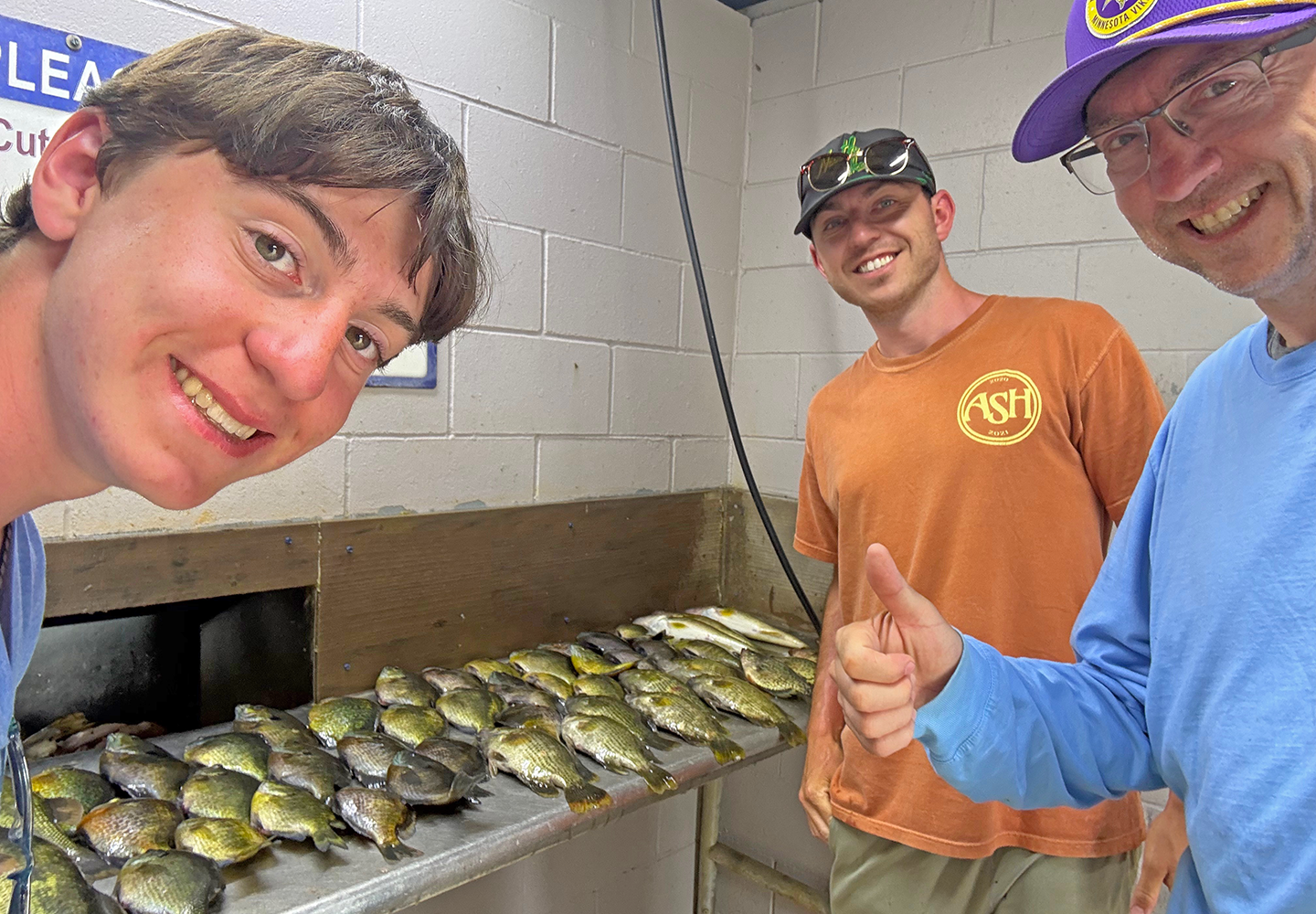 For me, perfecting any working theory is tricky, especially when I only have 7 or 8 hours of fishing time to get it done. Most days start with a “rough plan” of what I think I’m expecting, and end with a “post trip analysis” of what I wish I’d known before I started. Proving or disproving a theory, believe it or not, can actually be harder on days when fish are biting, than it is on days when they’re not.
Take my trip yesterday with Gabe, Isaac, and Mica for example. The lake, a relatively shallow, 1000-acre multi-species system, is one where I usually catch a little bit of everything. On most days, I’d expect a half dozen nice walleyes, some largemouth bass, a few crappies and when I’m lucky, maybe 8 or 10 nice sunnies.
On this Wednesday, we wanted to target walleyes as best we could, and my “working theory”, based on experience was that catching them on this lake would require finesse. Wiggle worming, a preferred mid-summer, weed line presentation, has worked well in the past, and was first up on my list. Like I said, I expected a mixed bag, but what I didn’t expect was that the sunfish would be on fire. I’m not prone to exaggeration, and typically don’t choose phrases like that, but they really were.
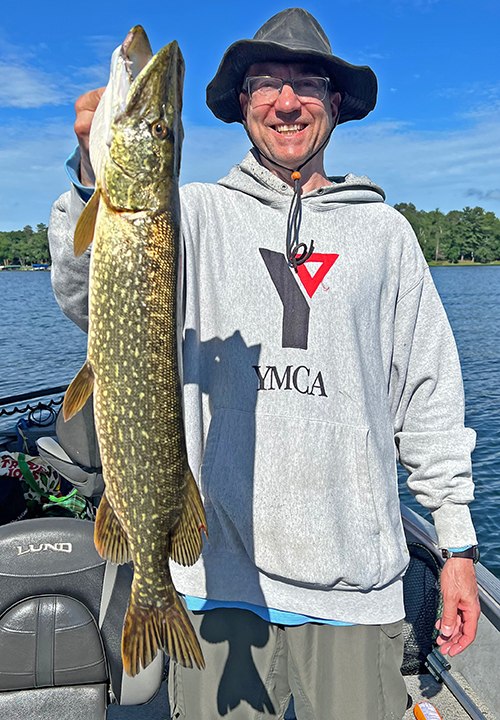 For us, getting a worm into the water and sneaking it past the bluegills where any other fish could find it was nearly impossible. I’m not complaining about that, there’s nothing wrong with good sunfish action and we did take advantage of it. However, after fishing 3 or 4 spots and catching lots of sunnies, it was time to try a different presentation. Spinners, fished over the tops of scattered patches of wild celery, coontail and clasping leaf pondweed provided more action. Now we were catching small northern pike, rock bass, more bluegills and eventually, one walleye. The walleye catch was encouraging but didn’t mark the start of a true walleye bite.
I tried figuring out “where” the walleyes were by checking deeper water, shallower water and mid-lake structures, but none of that worked. In the end, I figured out that the problem wasn’t location, the walleyes were in the weeds, along with all the other fish. The problem was the pecking order, panfish and small pike were so active that the slower moving, more deliberate feeding style of the walleyes simply put them at a feeding disadvantage. Once I got stubborn, and trolled spinners long enough, we did prove the point by catching a few more walleyes in the weeds. So, as expected, walleyes were in the weeds. That said, they unexpectedly preferred a faster, more aggressive presentation rather than the slower, finesse approach we offered them at first.
At days end, I pondered what difference it would have made if we’d used spinners first and skipped the wiggle worming session at the beginning of our trip. Who knows? But one thing’s for sure, if I reverse the order next time, something else unexpected will happen and the fish will let me know why I should have tried something else instead, that’s just the way it always seems to go.
One interesting topic that we talked about these past couple of days is the relationship between walleyes, and the bottom of the lake. Walleyes, despite what we’ve been told, spend most of their time well above the bottom. In fact, the most common disadvantage I’ve experienced is when anglers worry too much about finding “the bottom”. This is especially true when fishing in weeds, or mixed cover. Consider this, to a walleye, the top of the weeds IS the bottom. Look at the accompanying photo and study it, these walleyes are cruising the weed tops searching for a meal. If an angler’s bait is “on the bottom” it will pass underneath the fish, and they will not even realize it is there.
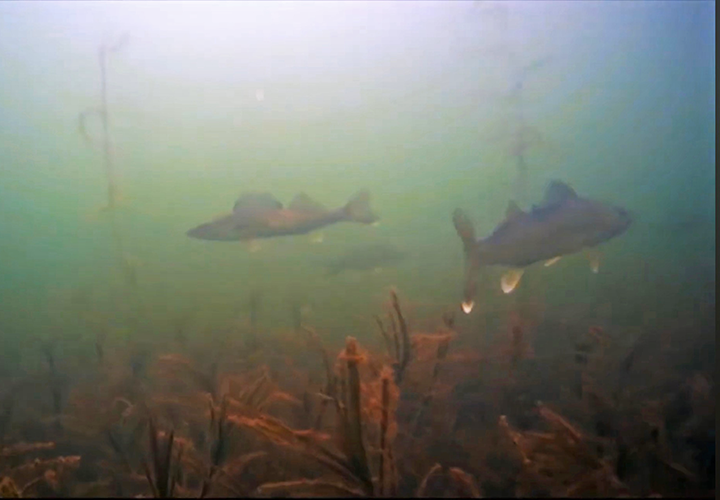 Whether you’re trolling spinners, casting jigs, using slip floats or using any other presentation, err on the side of fishing too high in the water column rather than too low. It may take a while to sink in, but it will lead you to more success.
Another notable takeaway from the past 2 days has been the expansion of the mid-summer mixed bag action bite. With water temperatures now hovering around 75 degrees, all species of fish are very active. Obviously, it will depend on the species your favorite lakes hold, but trolling the weeds using spinners will definitely produce fish.
On Tuesday, fishing the weeds on Leech Lake, we found sunfish, rock bass, a few crappies and as you can see pictured above, some better size northern pike. On Wednesday, the mix was sunfish, rock bass, small pike, a few crappies and walleyes with a smattering of largemouth bass.
Changing the live bait, we tipped our spinners with made a difference. Using small fatheads tipped the scales toward pike and crappies. Using night crawlers turned the sunfish on, and tipping our spinners with large leeches triggered some of the bass and rock bass. The walleyes we caught came on minnows, probably because the bluegills left them alone long enough for walleyes to locate them.
Okay, going forward, I think it’s safe to say that the mixed bag action bite will be reliable. Warm, maybe even hot weather is predicted for next week. Fans of the action bite should be in for a treat; walleye purists may struggle in the short term to produce great catches. Eventually though, warm weather will help intensify algae blooms, and that will help darken the clear waters of our larger walleye lakes like leech, Winnie, Cass and others. As that happens, we should begin hearing better reports about active walleyes in those systems.
 I’m headed into a busy period, with trips scheduled almost daily for the next couple of weeks. I’ll have plenty of fresh updates, so be sure to check in every day for news.
OH, by the way, one of my computers, the office machine I use for emails crashed and burned on Tuesday. I lost most all of the email addresses and recent correspondence with fishing customers. If you have expected to hear from me, and haven’t, it is because I lost your email address. So, if you would be so kind, use the link to my contact page and send me a quick email so I can update my address book. Thank You! — Jeff Sundin, The Early Bird Fishing Guide Call-Text 218-245-9858 • Email • Facebook • X • Subscribe Insider Newsletter
Ely Area, Arrowhead Outdoors Fishing Report July 8, 2026
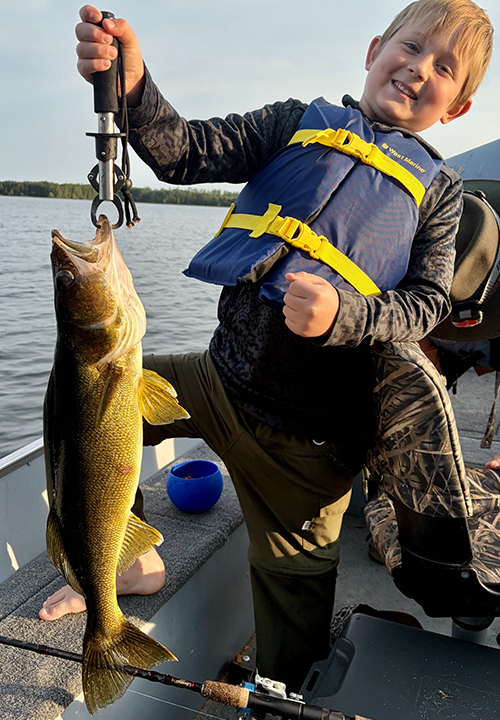 "Walleye fishing reports this last week indicate walleye scattered throughout the lakes now. Some anglers were finding active walleyes in 6 to 10 feet of water. These anglers were finding them on rocky, wind blown shorelines and points. Many anglers reported that harvested walleyes had crawfish in their stomach, so naturally crawfish colored baits produced the best here. Fish were caught while throwing paddle tails, bucktails, deep diving jerk baits or slip bobbers and a leech.
Other anglers found walleyes out on sunken islands or around islands a little deeper in that 15 to 20 feet of water range. Anglers finding walleyes out here were mainly fishing with spinner rigs, tipped with a leech or a crawler. There were anglers that did report minnows fished on a jig produced best for them, but overall leeches were the best choice. Hot colors this last weekend were orange/chartreuse, pink and gold.
Smallmouth bass action is starting to slow up a little for many anglers now as smallies are starting to disperse throughout the lake now. While anglers can still find active bass on shorelines while fishing with topwater, chatterbaits, wacky worms, crankbaits and in-line spinners, many anglers are finding bigger bass out on main lake structure, in that 15 to 20 feet of water, right now. Bass anglers fishing out here have been drop shooting straight tail minnows and urchin baits to catch bass. Some of the bigger bass anglers have been finding out here have been suspended just off the structure about 10 to 20 feet of water. Large cisco colored swim baits, fished on a heavy 3/8 to 1/2 ounce jig, have been deadly for these fish.
Panfish - Crappie anglers continue to report good crappie fishing on Ely area lakes during the evening hours in 6 to 12 feet of water. It's important to note that anglers are often catching these crappies 1 to 3 feet below the surface while throwing beetle spins, jig/twisters or small minnow baits. Sunfish anglers continue to keep it really simple by fishing with small leeches or red worms, under a bobber in and around weedbeds in that 5 to 12 foot of water range.
Northern Pike anglers reported a slow bite this last week as water temps continue to rise to temperatures big pike don't like. On the other hand pike in that 30 inch class and down were a common catch for anglers. Large spoons, large swim baits and even large topwater baits were all very effective for triggering these pike. River mouths and weedbeds in that 8 to 12 feet of water, were the areas to focus on pike
Stream Trout - Stream trout anglers continue to find plenty of active trout on area stream trout lakes. Anglers continue to mainly fish with cowbells, tipped with small brightly colored minnow baits, about 10 to 20 feet down, while trolling over deep water. Anglers fishing from shore continue to have good luck catching trout with a nightcrawler, fished under a bobber about 10 to 15 feet down. This bite has been best in the early morning hours or late evening hours for these anglers.
Lake Trout - Lake trout anglers reported mix results this last week. This is not uncommon for this time of the year as the thermocline starts to set up over deeper water. Anglers fishing with downriggers reported having the best luck in that 30 to 40 foot of water range. Large cisco colored trolling spoons did best out here. Anglers fishing from canoes or without downriggers struggled. These anglers mainly vertically jigged with heavy tubes, squid tails and bucktails over water depths ranging from 40 to 80 feet of water." — Arrowhead Outdoors, 218-365-5358
Wired2Fish July 8, 2026 "Garmin Unveils New LiveScope: The Details on The All-New LiveScope 2 Live-Scan Sonar Series"
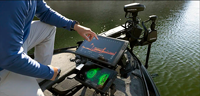 "Marine electronics juggernaut Garmin announced the launch of its LiveScope 2 Series, marking the next generation of its live-scanning sonar technology. As you probably know, Garmin’s LiveScope allows anglers to see real-time views of fish, bait, and structure around the boat.
The updated lineup introduces three new transducer models that feature increased resolution, expanded sonar coverage, and a redesigned installation process that completely eliminates the need for an external black box module. This updated technology provides anglers with real-time imagery beneath the water, offering significantly improved target separation and reduced display noise.
Garmin’s LiveScope 2 Series introduces several technical upgrades designed to provide clearer imaging as fish and lures move through the ..." Read Full Story >> Garmin Unveils New LiveScope: The Details on The All-New LiveScope 2 Live-Scan Sonar Series
Lake of the Woods Fishing Report July 8, 2026
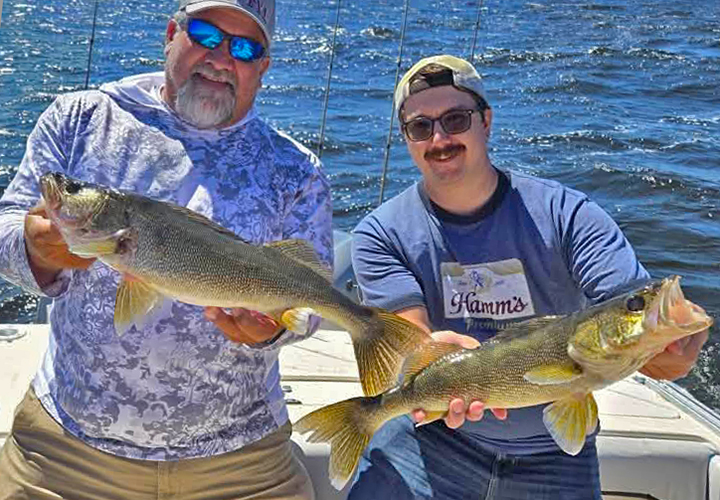 "Summer walleye patterns are in place on Lake of the Woods. Big schools of walleyes and saugers are out on stretches of deep mud, and fishing has been excellent across the system. Most anglers are drifting spinners and crawlers right now, but some are still jigging or trolling crankbaits, and all three methods are working nicely. Here's where things stand across the three areas this week.
On Big Traverse Bay (South Shore), the big schools of walleyes are out on the deep mud across Big Traverse Bay, and there's more than one good way to get at them. A common question this time of year is when to pull spinners or troll cranks versus when to jig, so here's a quick way to think about it.
When fish are spread out over a large area, spinners and crankbaits do a great job of covering water and putting your presentation in front of numbers of fish. The flash and vibration of a spinner blade, combined with the scent and action of a nightcrawler, is tough for a walleye to resist. Crankbaits work a little differently because they mimic an injured minnow or baitfish, and instinctively, walleyes notice that "injured" action. Even when they aren't actively feeding, instinct kicks in and they will often react.
 Jigs, on the other hand, shine when fish are more concentrated over mud, or schooled tighter by a piece of structure. Vertical jigging with a minnow, a piece of crawler, or at times even a leech can be dynamite when you're sitting on fish. In fact, amongst the islands around the Northwest Angle, some guides leave their jigs on all year long.
As for color, two things guide the choice. The first is the color of the water you're fishing. In the stained waters of Lake of the Woods and the Rainy River, gold combined with a bright color such as pink, orange, chartreuse, or glow white is a good bet. The second is the forage you're trying to imitate. For emerald shiners, lean on silver and blue. For crayfish, use orange, red, and gold. For perch, use green, gold, and orange.
The Rainy River continues to produce a nice mixed bag. Some anglers are heading there specifically to target sturgeon, while others are simply taking a day, or part of a day, away from the walleyes to hook into a dinosaur. Either way, tangling with one of these prehistoric giants is an experience that's hard to top, and they're in the river in good numbers.
Specific sturgeon regulations and dates for Lake of the Woods and the Rainy River are:
- Harvest (Keep) Season: April 24, thru May 7, 2026 and July 1, thru September 30, 2026.
- Catch and Release Season: May 8, thru May 15, 2026 and October 1, thru April 23, 2026.
- Closed Season: May 16, thru June 30, 2026
The river is home to a number of fish all year long including walleyes, sauger, smallmouth bass, pike, crappies and the list goes on. This is small water and doesn't see much traffic in the summer months compared to spring and fall.
Up at the Northwest Angle, there's a ton of structure in these parts, and it's loaded with fish. Walleyes will always relate to structure. That said, much like the south end of the lake, many walleyes are now sliding off the reefs and out over stretches of mud.
On the Minnesota side, Little Traverse Bay, which extends along the Canadian line south of Oak Island and east of Little Oak, is holding good numbers of fish this time of year. Making long drifts with a 2-ounce bottom bouncer paired with a spinner and crawler is tough to beat here. Similar pockets of mud exist off the deep sides of structure throughout the islands region. Other areas with a mud bottom may not be as large, but they can still be super productive.
The muskie fishing is living up to its reputation, too. Good numbers of muskies are being caught and released right now. These waters are known for some of the best muskie fishing in the nation, and the current reports are proving that.
Before You Go: A quick reminder on the regulations. The combined walleye and sauger posession limit is 6 fish total, with up to 4 of the 6 being walleyes. All walleyes between 19.5 and 28.0 inches must be released immediately, one walleye over 28.0 inches is allowed in posession. A 2026 Minnesota fishing license is required.
Summer fishing has been excellent, and the walleye action is about as consistent as it gets. Whether you jump in with a fishing guide, hop aboard a charter, or bring your own boat, there's good fishing to be had right now. When walleye fishing in other parts gets tough during the summer due to millions of minnows and young of the year fry, excessive weed growth and heavy recreational boat traffic, summer walleye fishing shines up at Lake of the Woods and is very consistent." — Lake of the Woods Tourism, (800) 382-FISH
Today's Feature Fishing Report: July 6, 2026 "Legendary Minnesota Fishing Icon Dies At 77"
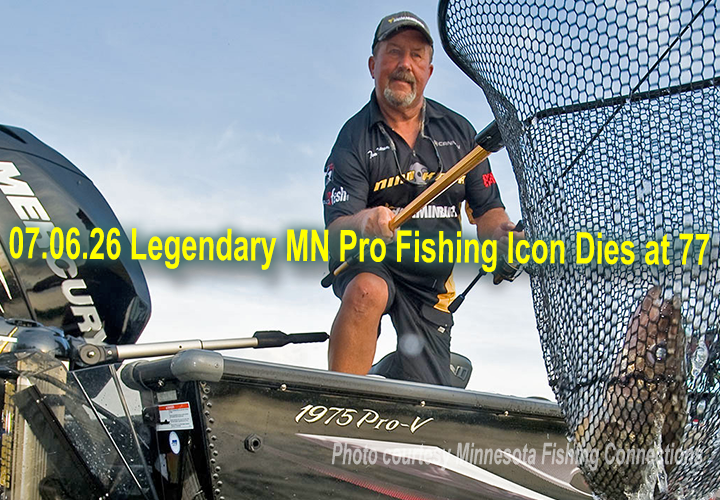 "Tom Neustrom, Grand Rapids Minnesota passed away at his Itasca County home on Sunday July 5, 2026.
In a fishing career spanning 5 decades, Neustrom, age 77, was an influential fishing guide, media contributor, outdoor industry promoter and fishing activist. In 2009, Tom Neustrom was inducted as a Legendary Guide into the National Freshwater Fishing Hall of Fame in Hayward, Wisconsin. Inducted into the Minnesota Fishing Hall of Fame in 2015, Neustrom had numerous additional career credits. Neustrom provided anglers with professional guided fishing trips, fishing seminars, and media appearances including frequent appearances in the early days of In-Fisherman TV and print publications.
Guiding groups, like the Northern Minnesota League of Guides, Minnesota Fishing Pros, Leech Lake Guides Coalition and others, counted Neustrom among their ranks.
Neustrom was a founding member of the initially private “Walleye Advisory Committee”, which led to the formation of Minnesota DNR’s pilot project, the “Walleye Work Group”. Once established, the DNR workgroup project expanded into more species-specific groups such as bass, panfish, catfish, northern pike and others.
Neustrom remained active as a volunteer with the Walleye Workgroup, and other fishing related organizations. Most recently, he was a founding member of MN-FISH, a high-level fishing organization that strongly influenced Minnesota legislators to approve funds from Minnesota’s general fund to the Minnesota DNR for boat ramp, fish hatchery and public fishing piers development and improvements. Neustrom was elected to, and remained on the executive board of directors for MN-FISH at the time of his passing. As an activist, Neustrom was a driving force behind Minnesota’s current effort to establish a statewide 4-walleye possession limit. Also strongly advocating for state licensing of Minnesota’s working fishing guides.
Without doubt, Neustrom’s influence on the sport of fishing has been, and will continue to be felt long into the future.
At the time of this writing, no known plans for funeral, or celebration of life services have been set. Women on Winnie’s, Judi Hart, who maintains a close relationship with the Neustrom family advises that we’ll be kept in the loop as details become available, frequent updates will be provided." — Jeff Sundin, Call-Text 218-245-9858 • Email • Facebook • X • Subscribe Insider Newsletter
July 2, 2026 "Repelling the Repel-Able: Get Protected From Biting Flies"
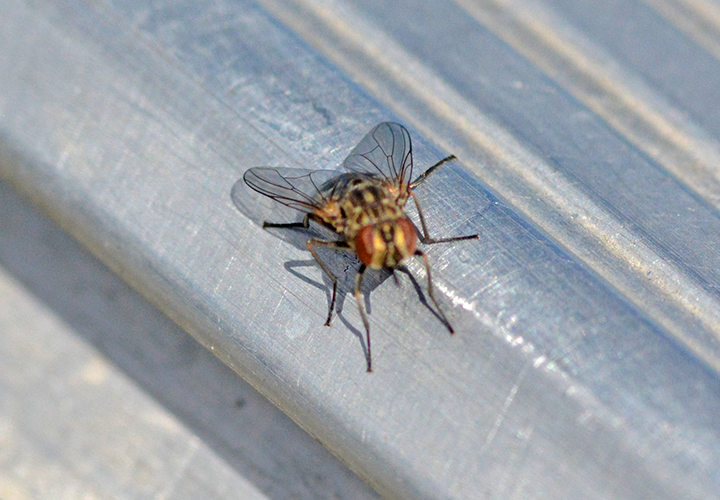 On Wednesday, I teased facebook friends with a photo of one personal archenemy, a variety of Sarcophagidae that I believe is called a flesh fly. The reason I’m not sure about the identification is that flesh flies can be mistaken for stable flies, a biting fly that often thrives around cattle pastures, farms, and the like.
Unlike stable flies, which do bite humans and leave painful, itchy sores on our skin, flesh flies are actually not “biting” in the conventional sense. Instead, flesh flies are attempting to feed on decaying matter trapped in the pores of our skin. The pin prick, or sharp tickling sensation from them digging around in our skin is just as annoying and painful but does not leave a mark. So, why I “think” I can tell them apart is that I, and my customers have had lots of so called “bites” but show no physical signs of a sore, or itchy area after the attack.
Be that as it may, either variety of the Sarcophagidae are equally irritating to anglers, and my reason for sharing the photo was to promise 2 effective solutions for keeping them from nipping at our ankles.
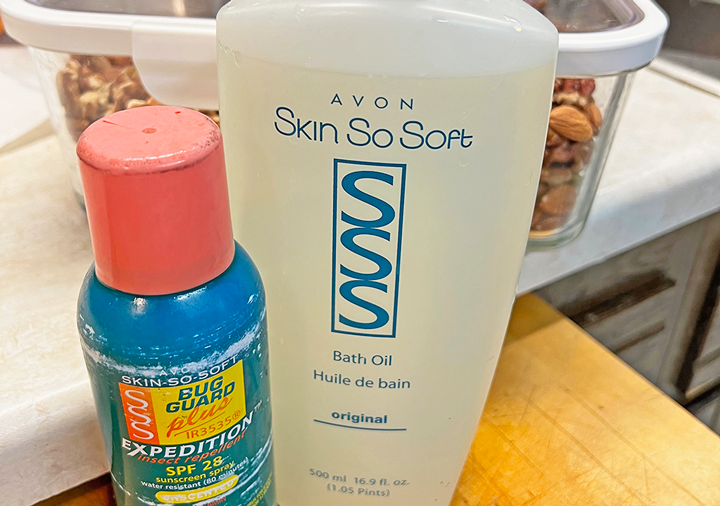 First off, my non-bug-repellent solution for warm summer weather are a pair lightweight pants from outdoor sports. The material is ultra lightweight, like parachute fabric, and feels cool on my skin. I can wear these pants without feeling miserable, even during the hottest days of summer. I like to wear one size larger than my true size, so the extra fabric covers my ankles completely. The result is hours of comfort, even on days when people around me are being pestered by the flies.
The bug spray solution, for anyone who insists on wearing shorts, or clothing that leaves the ankles exposed is Avon Skin So Soft. Lots of you may already know that I’ve used this product for years and have reported great results. Whatever the active ingredient is, the flies do not like it and they will stay away from your ankles while you have it on.
There are 2 forms of the Skin So Soft that work equally well for keeping the flies away. The original bath formula is a lotion that can be applied by hand, and I’ve had very good results using it. The second form is called the expedition formula, and to this product, Avon added an SPF 28 sunscreen. The expedition formula comes in a spray can, it is easily applied and offers protection from other bugs, like mosquitoes, deer flies and other annoying non-biting insects as well.
 My main reason for moving away from the insect repellents was their cost, at 15 to 20 dollars per bottle, using either of these products every day can get expensive. This is especially true when you’re sharing the products with 2 to 3 other crew members each day of the summer. That said, for any family who occasionally goes fishing, and does not require large supplies, the repellents are a really good option.
I’m not proud of myself for buying the pants on Amazon, but there are times when the super retailer is simply the only way to get what I need when I need it. That said, I have begun seeing similar, but not identical items for sale in some of the larger retail stores. Do your own research if you like, but for convenience, I have included a link to the items on Amazon. So, if it suits you, use this link to order a pair of >> TBMPOY Men's Lightweight Hiking Travel Pants.
For folks who prefer the insect repellent solution, here are links to Avon’s website where you can order either >> Avon Original Skin So Soft Bath Oil or the >> Avon Skin-So-Soft Sunscreen Bug Guard Plus Expedition SPF 28
Whichever option you choose, I and our fellow anglers would love to hear from you about the results. And if you have other solutions, we’d be equally interested in learning your favorite methods of protecting yourself from biting flies, and other annoying bugs. — Jeff Sundin, The Early Bird Fishing Guide Call-Text 218-245-9858 • Email • Facebook • X • Subscribe Insider Newsletter
July 1, 2026 "How Does Your Garden Grow?"
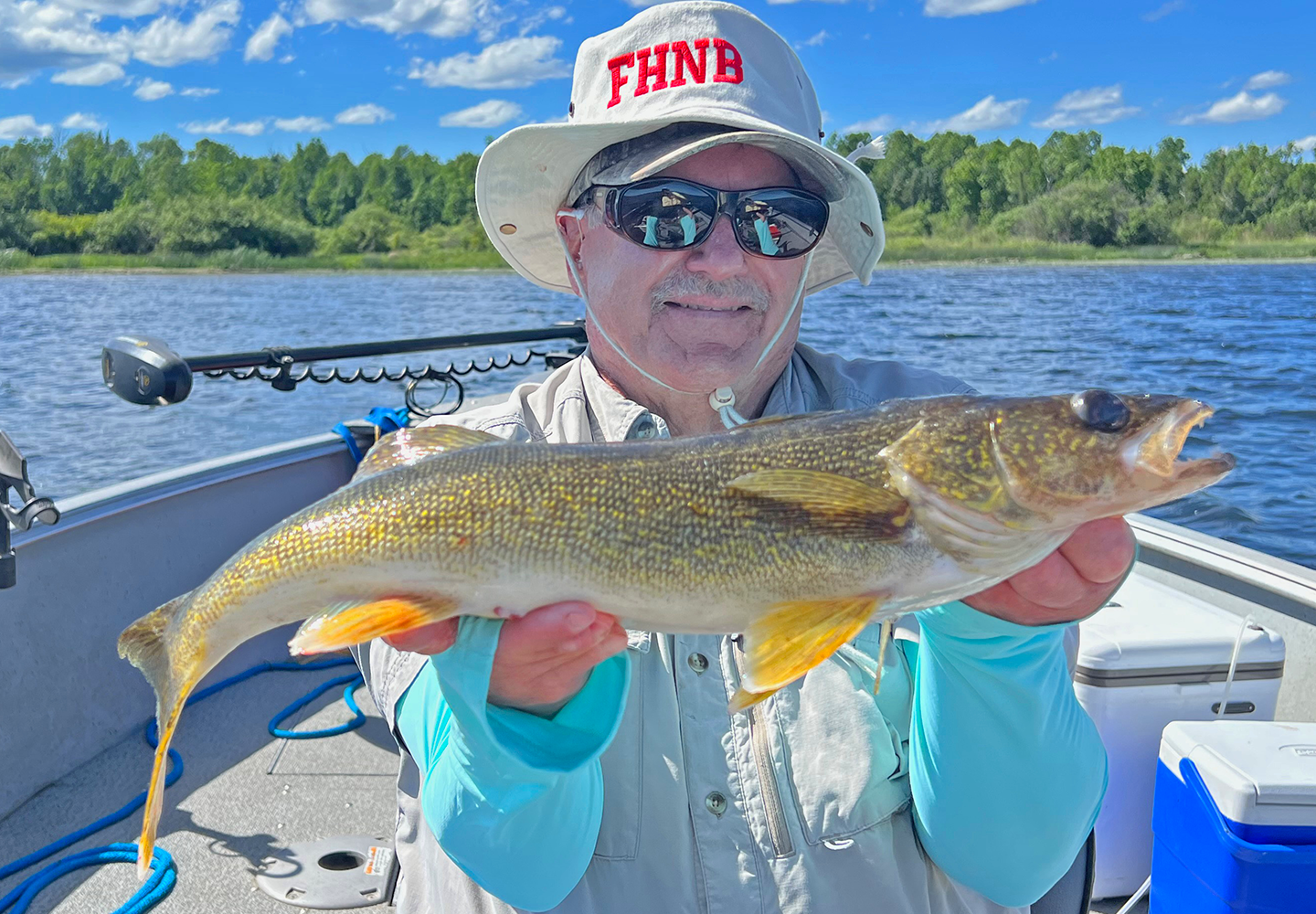 "Conversating with Steve Caron as we fished on Tuesday, I realized how much I have in common with Mother Nature this summer. I, for one thing, do not have my garden fully planted yet. Steve laughed when I told him that, but it’s not that I haven’t been trying, I have. I just can’t understand where the time has gone, every day seems to present some new delay in my plans.
The fishing season, in some ways, has followed the same trajectory. Cool water, lack of weed development, scattered fish … delay, delay, delay. Mother Nature, I think, must have been trying to get the season on track, but I guess there’s just so much going on that she can’t get around to it.
Like me though, I think she might finally be starting to get caught up. Water temperatures are on the rise (71 degrees where Steve and I fished on Tuesday), vegetation is developing and a wider array of fish populations have begun taking up residence in them.
On Tuesday, our pursuit of walleyes began on mid-lake structures, small bars with access to deep water. As I reported last week, small and scattered pods of walleye were held along the semi-soft, marl substrate transition regions. Wiggle worming scored us a few walleyes; jigs tipped with leeches scored us a few more. Had the southwest wind not become so strong, we may have continued to fish mid-lake structures all day. However, with whitecaps crashing into the transom of my Alaskan, and Steve’s walleyes already in the livewell, I decided to find calmer water and try fishing with spinners.
At first, I selected a couple of spots that featured steep breaklines adjacent to cabbage weeds. The drop off, from about 8 to 12 feet deep, was loaded with small size northern. Even if there were other fish present, the aggressive pike were grabbing our spinners so fast that the others never stood a chance to catch us. So, I opted to try a flat area in even shallower water.
I wasn’t confident about spots like this because the weed development has been behind schedule this year. Often, I’ve explored the flats in water depths of about 5 to 8 feet, and found little, if any, vegetation. This time though, the flats offered a whole new mix of vegetation and fish. There was a mix of eelgrass, along with some patches of wild celery and a smattering of scattered cabbage plants.
Our spinners, tipped with ½ night crawlers and trolled through the weeds at about 1.1 MPH did attract some perch, several more pike and a few walleyes too. The action was fast enough to make threading nightcrawlers tedious, so we started using minnows instead. Switching bait didn’t seem to matter, the mix of fish was about the same either way.
I wouldn’t call it a full-scale mixed bag bite that we often see during midsummer. It did seem though that we got in on the early stages of what will become one. Ironically, the largest walleye Steve caught yesterday, pictured above, was caught on the spinners, rather than when we were using the jigs and live bait. That fish struck a spinner and minnow combo in about 6 feet of water.
Okay, I guess it’s fitting that today, July 1st, offers the first report about summer fishing patterns. While I’m not quite ready to declare the official start of the mixed bag, action bite for 2026, I do see it coming. With water temperatures at 71 degrees, they are approaching the ideal range for it. And with vegetation taking shape in the shallows, fish populations will gather in larger numbers, and there will be an even wider range of species available to catch. So, it’s time to broaden your array of spinners, sinkers and terminal tackle; trolling time is coming soon." — Jeff Sundin, The Early Bird Fishing Guide Call-Text 218-245-9858 • Email • Facebook • X • Subscribe Insider Newsletter
Ely Area, Arrowhead Outdoors Fishing Report July 1, 2026
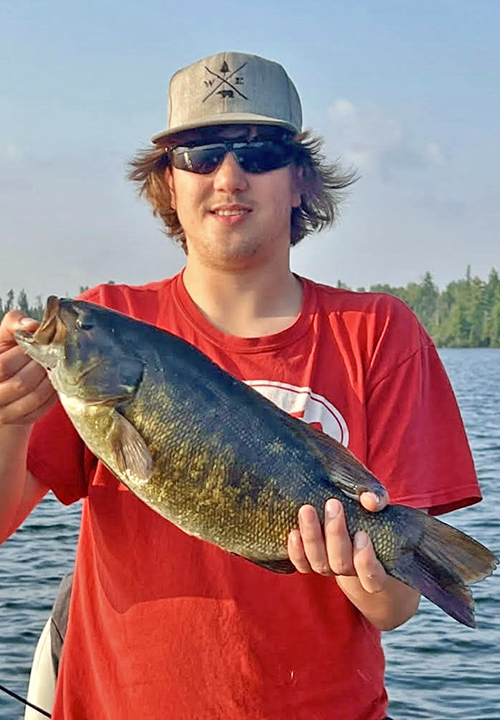 "Little has changed with the walleye fishing this last week. Mayflies continue to hatch on many Ely area lakes, but based on reports from cabin owners, resort owners and guides they seem to be past peak in many areas. As insect hatches wane, walleye fishing continues to improve for anglers.
As with last week, knowing if and where mayflies are hatching on your lake has been key to many angler's success. If mayflies are still hatching, crawlers have been the best choice. Spinners rigs, whistler jigs and death jigs, tipped with half a crawler, fished over mud flats in that 15 to 23 feet of water, have been very effective.
If the mayflies are done on the lake or you are fishing a smaller lake where they are not that big of an issue, leeches continue to be the best bait for walleyes. Anglers fishing these lakes have been having great luck tipping spinner rigs with a leech, slip bobber and a leech, throwing paddle tails and deep diving jerk baits in 6 to 20 feet of water. Rock and rock to sand or mud transition areas have been the key here. If the wind has been blowing into these rocks, even better. Hot colors this last week were orange/black, gold and orange.
Smallmouth bass anglers continue to enjoy a very strong bass bite this last week. Anglers continue to catch bass on a wide range of lures, depending on the time of the day. Early in the mornings top water continues to be red hot in shallow water, over rocky flats, in rivers and around river mouths. When the sun gets up wacky worms, chatter baits, crank baits, jerk baits, in line spinners, and spinnerbaits are all catching tons of smallmouth bass, but in a little deeper water ranging from 8 to 15 feet of water right now. Stick to the rocks and rock transitions area as the sun comes up. Hot colors this last week have been loon, green pumpkin and orange/pumpkin.
Panfish - Crappies and sunfish continue to be found in or near emerging weed beds, but just like bass and walleye, the time of day often determines what you will find near or in those weeds. During the day sunfish often dominate the weed edges and weed beds, but as the sun goes down crappies are quick to move in. Angler's targeting sunfish have been having great success with red worms, wax worms or angle worms, all fished under a bobber. Crappie anglers have been having great success throwing small twister and paddle tails, swimming them about 1 to 3 feet below the surface to catch crappies. Hot colors were white, sext shad and pink.
Trophy northern pike fishing is starting to cool off as water temps start climbing into the range trophy pike don't like. Many anglers have noted that they are still catching numbers of pike while throwing large spoons, swim baits and large top water baits for pike. Weed beds have become the best areas to find active pike, but river mouths and even rivers have also been good areas to focus on pike too. Anglers should focus on 8 to 12 feet of water.
Lake trout anglers enjoyed a good week of fishing for lakers in 30 to 50 feet of water this last week. If anglers were fishing in a boat they were often trolling with down riggers for dipsy divers with large trolling spoons. If anglers were fishing from a canoe they were often fishing with large bucktail jigs, squid tail jigs and tube jigs. These anglers are often simply drifting over deep water while vertically jigging. Hot colors have been whitefish, white and pink.
Stream trout anglers reported mixed results this last week on area lakes. Many anglers reported the best fishing coming while trolling cowbells with a small, brightly colored minnow bait or small spoon. These anglers simply trolled over deep water while getting their cowbells down to that 15 to 20 foot range. Anglers fishing from shore have mainly been fishing with a slip bobber and angle worm about 10-15ft below the surface. Early mornings and cloudy days has been best for all anglers this last week." — Arrowhead Outdoors, 218-365-5358
You Are Invited To Become A Duly Deputized Fishrapper Cub Reporter Too!
 If you've been waiting for a gold engraved invitation to participate in the daily reports, then stop waiting and consider this your own personal invitation.
Helping your fellow fishermen and women stay abreast of fishing conditions in your area is good for everybody and it's easier than you think! You don't have to write a book, you don't have to share your secret fishing spots and you don't even have to mention your lake. You see, with just a few words about general trends, seasonal patterns or local weather conditions you can help steer your fellow anglers to more gratifying fishing experiences. So, be like Dan and Sean, and become a duly deputized "Cub Reporter", it's good for fishing and that's good for everybody!
Use the Contact Us page, or if you prefer to be "social", use our community page on facebook Fishing Reports Minnesota, that is the Facebook counterpart to this page and it is open to the public, so you can post your own fishing update or just share a photo of a nice catch.