Today's Feature Fishing Report: August 28, 2026 Sundin: "No Weeds, No Fish. Know Weeds, KNOW Fish!"
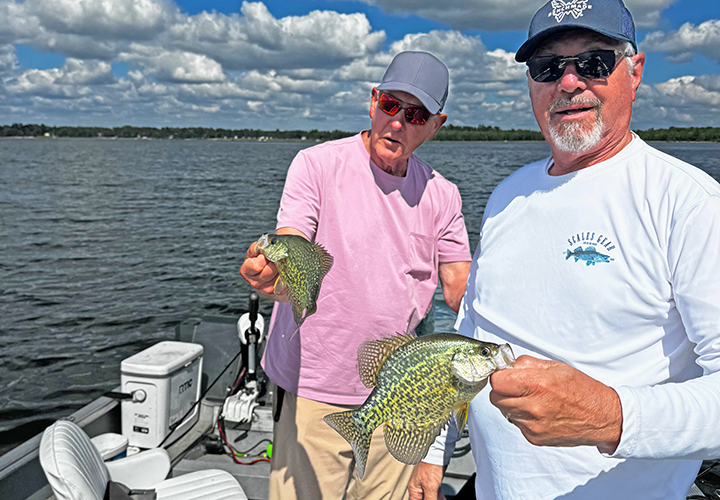 There’s always more than one way to catch a fish, that’s just how it is. But on any given day, there typically is 1 “best way” to catch a particular target species. Crappies, on a recent fishing trip, hunkered into the shade of vegetation, and if we wanted to catch them, we needed to coax them out of the heaviest cover.
You might be thinking, okay, that sounds good, I’ll just go out and find weeds on my favorite crappie fishing lake and start catching them. Hold on, it might not be quite that simple. The type of vegetation is important; not all weeds will be holding fish in your favorite lake. And to complicate the scenario even more, where the weeds are located may be equally important as what type of weeds they are.
A few weeks agon when I visited the medium size, mesotrophic lake, we found a mixture of crappies, sunfish, bass and pike on slow-tapering, weedy flats in 8 to 12 feet of water. At that time, it didn’t seem to matter which weeds we fished, they all held some of everything. So, on this more recent trip, I started the day by fishing the same types of cover. The problem was that on this trip, the fish were not there, we trolled for a half hour or so without catching much of anything.
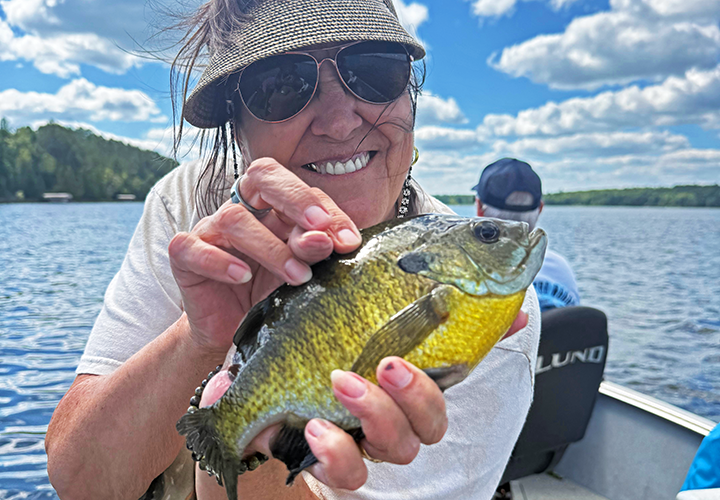 At first, I blamed it on the weather, calm seas, combined with sunny skies had them hunkered too deeply in the grass, I speculated. But my assumption changed when I tried something different, a similar weed patch laying adjacent to a steep breakline into the lake’s deepest water. At this location, crappies were in the weeds, and they were shallow, 8 to 10 feet of water. If I kept my crew’s spinners running through the snaggy patches of flat stemmed pondweed, they caught crappies. If I moved out to the clean edges of the grass in 12 to 15 feet of water, they caught sunfish, but never any crappies.
To test my theory, I tried another steep breakline with similar vegetation and it worked again. Crappies held tight to the shallower weeds, sunfish held deeper, along the outer edges of the weeds, but not deeper than about 15 feet of water.
By now, we had a solid pattern, and fish were coming into the boat regularly but dragging through the weeds was tedious. I’d hoped that we could zero in on the fish by switching to jigs and soft plastics. There was just enough breeze to make me think we could drift along the weed edges and let the plastic tails provide action and entice strikes.
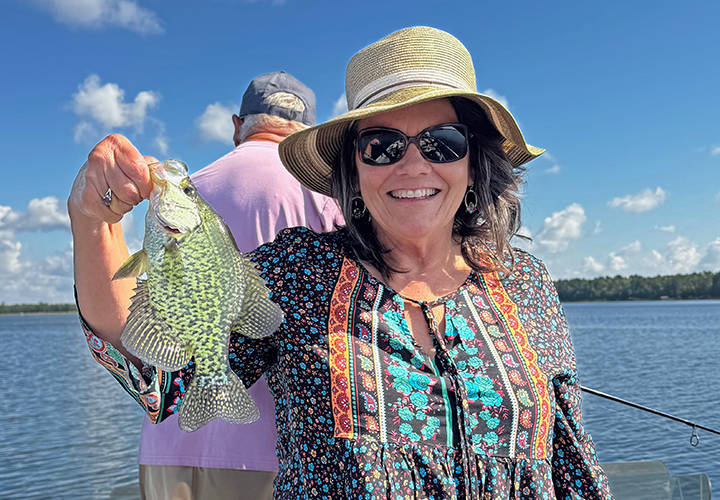 Rigging up 1/8-ounce minnow head jigs and tipping them with 2-inch Mr. Crappie, Slabalicious tails, we began a slow drift along the weed edges. To a degree, the presentation worked but again, the drift was so slow that making the tails swim required extra help. Casting, swimming, and breathing life into the plastics was tedious too, and not working better than the spinners. So, after a short break, we resumed fishing with spinners and minnows.
By days end, we were happy, the fish were not as large as the ones I’d found a few weeks back, but they weren’t bad either. Sorting through a lot of small fish, we managed to gather 20 fish mostly over 10 inches, including a few that were “close enough”, 9-3/4-inch fish to round out the crew’s limits.
The fishing was good, but in and of itself, might not have been the highlight of that trip. The Hippie Chick, Susan, was in attendance and had the chance to meet another, maybe the original Hippie Chick, Cyndi Sue, the better half for my longtime customer, and friend Paul Guanzinni. To say that two “Hippie Chicks” hit it off would be the understatement of the month. They acted like sisters who hadn’t seen each other in a few years.
Fishing trips like that one reminds me about how much we over-emphasize the catch when talking about a fishing trip. The experiences, what we see, what we talk about, the stories we tell never get the attention they deserve. Eagles swooping down to grab fish off the surface, anglers dropping sunfish into old style wire baskets, loons fishing alongside the boat, those are the things we remember, not the “body count”.
If you’ve ever wondered how a guy who’s done a job for 42 year still looks forward to going to work, days like that explain it.
If you make it only about the fish, you are missing out on most of the happiest experiences. Obviously, we do enjoy the fishing and we love the catching too. Also obviously, I do enjoy sharing details about how and why we catch them. But hopefully when you read the reports, you get the “feel” of why people go fishing. We almost always catch enough to be happy, the trick is knowing that we were already happy to begin with. — Jeff Sundin, Call-Text 218-245-9858 • Email • Facebook • X • Subscribe Insider Newsletter
More Recent Fishing Reports
Cass Lake Perch 8-26 • Ely MN 8-26 • L.O.W Walleyes 8-25 • Lake Winnie Report 8-24 • Sundin Crappies 8-20 • Vermilion 08-14 • Winnie 08-11 • Sundin Sunfish 7-26-26 • Goettl History 7-24 • Delicious Bowfin 7-22-26 • Sundin 7-16 • Lake of the Woods 7-16 • Ely MN 7-16 • Winnie 7-14 • Sundin 7-14 • Leech Lake 7-9 • Ely MN 7-8 • L.O.W. 7-8 • Sundin Report 7-1 • Grand Rapids 6-20 •
Follow on X • Follow on Facebook
 Join And Become A Duly Deputized Fishrapper Cub Reporter
Helping your fellow fishermen and women stay abreast of the fishing conditions in your area is good for everyone and it's easier than you think!
Fishing Reports Minnesota is the Facebook counterpart to this page and it's open to the public. Be like me, become a duly deputized "Cub Reporter" and post your own pics and comments. If it's good for fishing, then it's Good For Everybody!